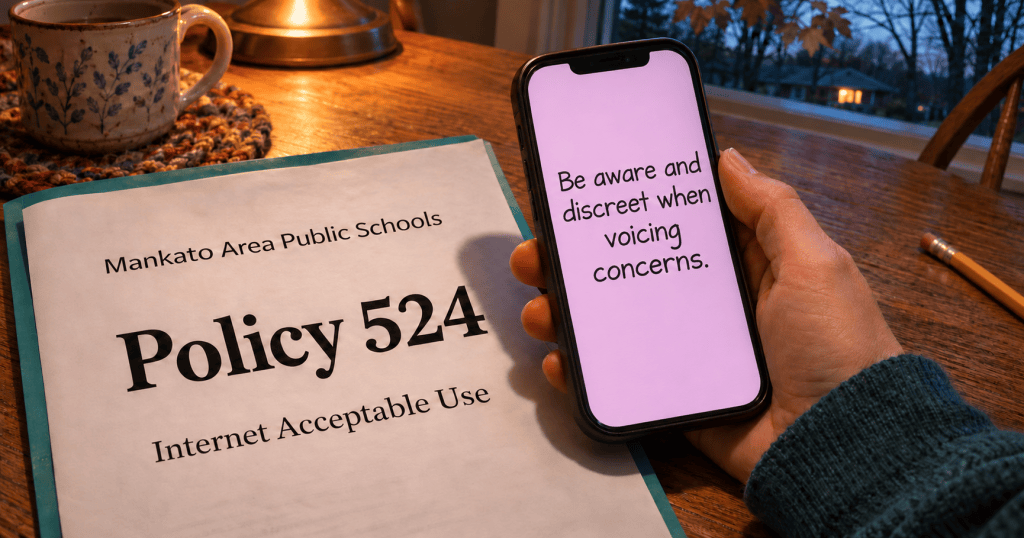
At the November 2 school board meeting, I asked the board to put in writing what happens when someone reports a student’s or a teacher’s personal online post.
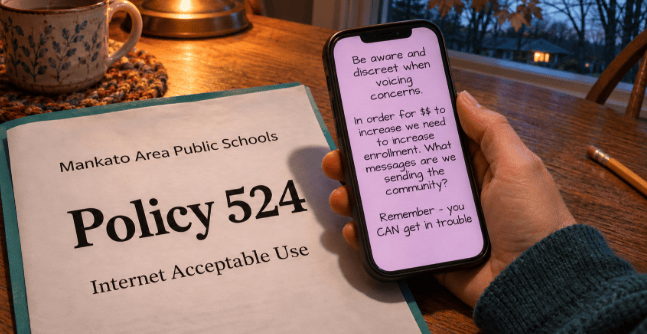
In 2022, while I was attending a coffee and conversations, the teachers were asking for more reading help for students. Following this meeting I saw a screenshot of a message cautioning teachers about what they said and how it was interpreted. I still think about the teacher on the receiving end of that message. If she believes students need more reading support, can she say so at a board meeting and then say the same thing from her own account that evening? She ought to be able to read our policies and understand where she stands.
On November 2, 2026, I offered amendments to Section V.B of Policy 524, Mankato Area Public Schools’ Internet Acceptable Use Policy. None received a second, so none came to a vote. Kari Pratt then moved to approve the four revised policies on the agenda, and Liz Ratcliff seconded. The package passed 6–1. I cast the dissenting vote, expressing that I appreciated the amendments but could not support the policy without stronger 1st amendment protections. The other three policies in that vote covered graduation requirements, literacy and the READ Act, and public data requests.
Watch the November 2 discussion of Policy 524 · Read the vote on page 6 of the minutes
Download the drafts and slides · See sources and earlier posts
What happens when someone sends the district a screenshot?
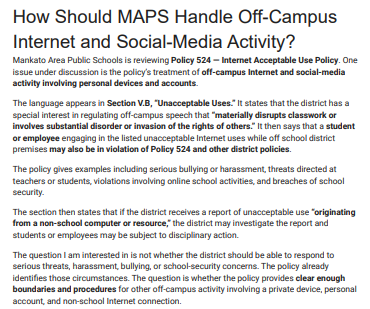
Section V.B applies to both students and employees. It lets the district investigate a report about certain internet activity on a computer or resource outside school. It identifies serious targeted bullying, threats and breaches of school security as examples, and expressly recognizes First Amendment rights. I want a principal who receives a screenshot of a threat against a student to have the authority to act. I also want a teacher who criticizes a district decision to know what facts would justify opening an investigation into her post. Read the adopted Section V.B.
We already answer part of that question elsewhere. Section IV of Policy 471, our employee social media policy, says the district does not monitor employees’ use of public online social media. It also allows the district to respond when it learns of or suspects conduct that adversely affects the workplace or violates professional ethics. If a teacher starts with Policy 524, how would she know to look in Policy 471 for that assurance? Read Policy 471, Section IV.
The cost of outside counsel and the question about speech
At the November 2 meeting, I asked John Lustig whether anything required Mankato to address student and employee speech in the same policy. He said he was unaware of such a requirement. He also explained the policy committee’s (Vice Chair Pratt and Director Roberts) concern about the cost of hiring outside counsel. The estimate he cited was $2,500 to $5,000 to draft a separate policy. A review limited to the wording of Section V.B would be a narrower assignment. Watch my question at 9:03 · Watch Lustig discuss the cost at 9:30
Later, Lustig explained how he understood the First Amendment language already in Section V.B. Patrick Baker asked what would happen if a student criticized the high school redesign on Instagram. He then asked about a teacher making a similar post from home. Those examples get at what concerned me. If someone complained about either post, could the student, the teacher, and the principal all read our policy and tell which rules applied? I wanted the policy to say that criticism by itself does not establish a violation and to spell out what the district would need to document before taking a complaint further. Watch Lustig’s explanation at 20:43 · Watch Baker’s examples at 21:00 · Watch my explanation of my vote at 23:07
The changes I asked for
The minutes record the outcome without transcribing the motions. The quotations below are from my prepared language. I’ve also summarized what each change was intended to do.
The three amendments I offered to Section V.B
24:23 · Amendment 1 — Protect criticism and advocacy for students
“Criticism of district policies and practices, employees, administrators, or school board members, advocacy for student services, or expression of political, religious, or other personal viewpoints do not, standing alone, establish bullying, harassment, or material and substantial disruption. Offense, embarrassment, disagreement, or the number of complaints received shall not, by themselves, establish a policy violation. Any determination of a violation must identify the specific conduct and the applicable policy standard. Nothing in this paragraph prevents the district from addressing true threats, unlawful harassment, or other conduct that independently meets an applicable legal or policy standard.”
- Suppose ten people report the same post asking the board to change how it teaches reading. The principal has ten reports to consider. The words in the post and their effect at school are still what the district should examine.
2. Define when a report becomes an investigation
25:45 · Amendment 2 — Define when a report becomes an investigation
“The district does not routinely monitor students’ or employees’ personal, off-campus internet activity. The district may receive and assess reports of potentially prohibited conduct, including anonymous reports. Before initiating an investigation beyond the initial assessment, the district shall document the specific alleged conduct, the potentially applicable policy provision, and the factual basis connecting the conduct to a legitimate school or employment concern. Investigations shall be reasonably limited to that concern.
Receipt of a complaint does not itself establish a violation. When material and substantial disruption is asserted, the district shall document the specific facts supporting actual disruption or a reasonable forecast of such disruption under the applicable legal standards. These requirements do not delay emergency protective action or legally required reporting or investigation. When immediate action is necessary, the basis shall be documented as soon as practicable.”
- My proposal leaves room for a student to report a safety concern anonymously. It asks the administrator to write down what happened and why the school has a reason to investigate. If the concern is disruption, I want the record to say what was disrupted or what facts gave the school reason to expect disruption. A complaint about one message should have a defined scope.
3. Explain which rules apply when an employee speaks
27:22 · Amendment 3 — Apply the appropriate standards to employee speech
“Employee speech shall be evaluated under the legal standards applicable to public employees, including relevant distinctions between speech pursuant to official duties and speech as a private citizen. When employee speech is reviewed under this policy, the district shall identify the applicable employee policy, including Policy 471 when relevant, and follow applicable employee procedures and collective bargaining requirements. Restrictions governing use of district technology shall not automatically be applied to personal, off-campus speech merely because the speaker is a district employee.”
- I wanted Section V.B to direct administrators to the appropriate employee policy, including Policy 471, and to identify whether an employee spoke as part of an assigned duty or as a private citizen on a matter of public concern. Sending families an official district message is one thing. Writing a personal letter to the editor about the school budget is another. A rule for students, or for using a district device, should not automatically decide whether a teacher can be disciplined for the letter.
Why I asked for separate language
When I asked where Section V.B of Policy 524 came from, the Minnesota School Boards Association pointed me to its 2021 revision of the model policy following Mahanoy. That case involved a student who posted on Snapchat over the weekend to vent about school and cheerleading. The school suspended her from the junior varsity cheerleading team for a year. The Supreme Court ruled in her favor while recognizing that schools can still respond to serious off-campus conduct, including threats and severe bullying. · Read the Mahanoy decision
Pickering involved a question familiar to anyone who follows a school budget. A teacher wrote to his local newspaper criticizing how the school board divided money between academics and athletics. The board fired him. The Supreme Court weighed his interest in speaking as a citizen about a public issue against the district’s interest in running its schools and ruled in his favor. I want our policy to make clear which rules apply when a student speaks off campus and which apply when a school employee speaks as a private citizen. Read the Pickring decision
In July, I submitted a proposal under Policy 208 asking the board to review Policy 524, on internet use, and Policy 471, on employee use of social media, together. At the October 5 first reading, we discussed monitoring, investigations, and the use of personal devices. The next day, I followed up in writing. What starts an investigation? How far can it go? If the district asks someone to take down a post, is that request voluntary? For many families, the first time those questions come up is when the phone rings. Read my July proposal · Watch the October 5 discussion
What if a teacher who posts from home, on a personal social media account, asking the district to provide more reading support for students. What if someone sees that request as criticism and says it disrupts the classroom? Before opening an investigation, what facts would the district need to show a connection between the post and what is happening at school?
I want staff to feel confident speaking up when they see students who need help. I also want students, families, and employees to know what to expects if someone raises a concern about something they posted. The district should be able to point to the specific words or actions at issue, explain which rule applies, and tell the people involved what happens next. That is what I wanted my November 2 vote to reflect.
Download the proposals and slides
Earlier source documents
- My October 6 written follow-up before the second reading (PDF)
- Mankato’s marked-up 2026 review draft (PDF)
- 2021 MSBA/MASA model-policy redline (PDF)
- Earlier employee social media discussion draft (DOCX)
- October 30, 2026 school law seminar handout by Timothy A. Sullivan (PDF)
Meeting record and earlier reading
November 2 and earlier meetings
- November 2 · Policy 524 meeting clip
- November 2 · Official minutes, page 6
- November 2 · Agenda, item 8.C
- November 2 · Download the full agenda packet (PDF)
- Full meeting recording · Select School Board, Nov. 2, 2026 (2 hr 36 min)
- October 5 · First-reading clip on speech, privacy and personal devices
- October 5 · Full school board meeting
- April 6 · Earlier school board meeting
Mankato policies and their history
- Mankato Policy 524 as revised on November 2, 2026 · Section V.B on page 5
- Mankato Policy 471 · Employee use of social media, Section IV on page 2
- Mankato’s earlier Policy 524 · PDF linked in my October post
- October 2026 review draft showing proposed changes · Google Docs
- December 2021 Mankato changes · Document linked in my 2025 posts
- Policy 524 document linked in the September 2025 discussion
- Policy 422 document linked in the April discussion
- Mankato district policy directory · Includes Policies 208, 403, 406, 471, 506, 515, 524 and 542
My previous posts and community poll
- Sept. 7, 2025 · Have we struck the right balance on off-campus speech?
- Oct. 14, 2025 · Two possible revisions for public input
- April 4, 2026 · Policy 422, professional expectations and personal speech
- July 28, 2026 · My full proposal for Policies 524 and 471
- July 28, 2026 · My request for a board review of the proposed policies
- Oct. 2, 2026 · Five approaches to off-campus internet activity
- Minnesota comparison graphics from the October post · First graphic
- Minnesota comparison graphics from the October post · Second graphic
- KEYC interview · Superintendent Peterson on the eligible families study and how families described unresolved concerns
Policies from other school districts
- Westonka · Policy 5160, internet and technology use
- Centennial · Policy 430, employee use of social media
- White Bear Lake · Policy 524, electronic technologies
- Brainerd · Policy 440, social media use
- Faribault · Policy 524, internet, technology and cellphones (PDF)
- Minnetonka · Policy 524, electronic technologies
- Edina · Policy 524 and its social media guidelines (PDF)
- North Carolina School Boards Association · Sample policy referring employees’ personal websites to Policy 7335 (PDF)
Legal sources and background
- 2021 MSBA/MASA · newsletter explaining the change to Model Policy 524
- Tinker v. Des Moines (1969) · Student expression at school
- Mahanoy Area School District v. B.L. (2021) · Off-campus student speech
- Pickering v. Board of Education (1968) · A teacher’s letter to the editor
- Connick v. Myers (1983) · Matters of public concern
- Garcetti v. Ceballos (2006) · Speech made as part of assigned duties
- Lane v. Franks (2014) · Citizen speech by a public employee
- Mayfield (8th Cir. 2024) · Applying the public-employee speech standard
- Lindke v. Freed (2024) · When a public official acts for the government on social media
- Minnesota Statutes § 121A.031 · School bullying policy
- Navigating Free Speech Issues in K–12 Schools · 2025 MSBA conference slides *
- Say What! Staff and student speech in schools
The three amendments begin at 24:23, 25:45, and 27:22.
Important moments in the November 2 clip
| Time | What happens |
|---|---|
| 1:10 | John Lustig introduces the proposed changes to Policy 524, including language on personal devices and the use of district technology to alter images. |
| 7:46 | You ask who decides what Mankato adopts. At 9:01, you receive confirmation that the board can choose its own wording. |
| 9:03 | You ask whether anything legally prevents the board from separating student and employee speech. At 9:30, Lustig says he is unaware of such a requirement and explains the committee’s concern (Vice Chair Kari Pratt and Director Erin Roberts) about the cost of drafting another policy. |
| 11:41 | You ask what triggers an investigation. At 12:36, you describe staff concerns that advocating for students could be characterized as disruptive if families leave and enrollment falls. |
| 14:19 | You ask what the district must document before acting on someone’s speech. Lustig answers that it depends on the allegation. |
| 16:12 | You describe parents’ reports about bullying-related posts being removed. At 17:04, you clarify that you could not verify whether administrators asked moderators to remove them. |
| 21:00 | Patrick Baker asks whether a student could be disciplined for criticizing high school redesign on Instagram. At 21:28, he poses a similar example involving a teacher posting from home. |
| 23:07 | You explain why you cannot vote yes without further safeguards. At 23:33, the chair explains that each amendment needs a second to reach a vote. |
| 28:43 | The board takes the voice vote. None of your amendments received a second. The four-policy package passed 6–1, with you voting no. Google Docs |
The three amendments I offered to Section V.B
24:23 · Amendment 1 — Protect criticism and advocacy for students
Criticism of district policies and practices, employees, administrators, or school board members, advocacy for student services, or expression of political, religious, or other personal viewpoints do not, standing alone, establish bullying, harassment, or material and substantial disruption. Offense, embarrassment, disagreement, or the number of complaints received shall not, by themselves, establish a policy violation. Any determination of a violation must identify the specific conduct and the applicable policy standard. Nothing in this paragraph prevents the district from addressing true threats, unlawful harassment, or other conduct that independently meets an applicable legal or policy standard.
25:45 · Amendment 2 — Define when a report becomes an investigation
The district does not routinely monitor students’ or employees’ personal, off-campus internet activity. The district may receive and assess reports of potentially prohibited conduct, including anonymous reports. Before initiating an investigation beyond the initial assessment, the district shall document the specific alleged conduct, the potentially applicable policy provision, and the factual basis connecting the conduct to a legitimate school or employment concern. Investigations shall be reasonably limited to that concern.
Receipt of a complaint does not itself establish a violation. When material and substantial disruption is asserted, the district shall document the specific facts supporting actual disruption or a reasonable forecast of such disruption under the applicable legal standards. These requirements do not delay emergency protective action or legally required reporting or investigation. When immediate action is necessary, the basis shall be documented as soon as practicable.
27:22 · Amendment 3 — Apply the appropriate standards to employee speech
Employee speech shall be evaluated under the legal standards applicable to public employees, including relevant distinctions between speech pursuant to official duties and speech as a private citizen. When employee speech is reviewed under this policy, the district shall identify the applicable employee policy, including Policy 471 when relevant, and follow applicable employee procedures and collective bargaining requirements. Restrictions governing use of district technology shall not automatically be applied to personal, off-campus speech merely because the speaker is a district employee.


Leave a Reply