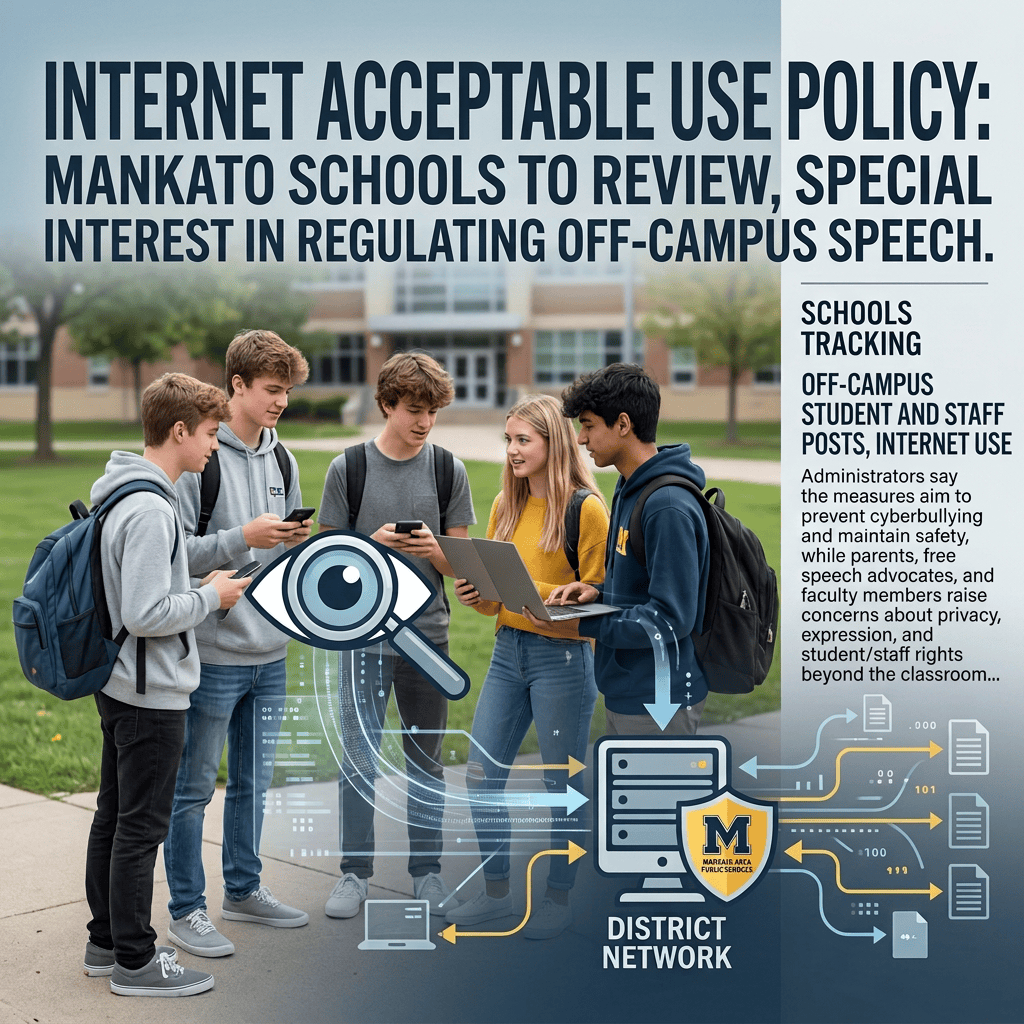
Mankato Area Public Schools is reviewing Policy 524 — Internet Acceptable Use Policy. One important question is how far the policy should extend into off-campus Internet and social-media activity on personal devices and accounts.
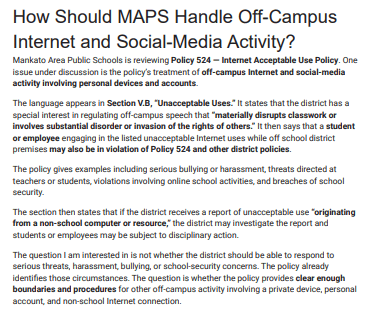
The district’s current Policy 524 already goes beyond activity occurring solely on school computers or school networks. In its section on unacceptable uses, the policy states that the district has a special interest in regulating off-campus speech that materially disrupts classwork, causes substantial disorder, or invades the rights of others. It specifically identifies examples such as serious bullying or harassment, threats directed at students or teachers, violations involving online school activities, and breaches of school security. The policy also states that, when the district receives a report involving unacceptable Internet use originating from a non-school computer or resource, it may investigate and potentially impose discipline under other district policies.
That means the Board is not starting from a policy that applies only to school-owned technology. The existing framework already recognizes circumstances in which off-campus online conduct can become a school matter. The question is whether those boundaries are defined clearly enough for students, employees, families, and administrators to understand when private online activity crosses into an area the district may investigate or discipline.
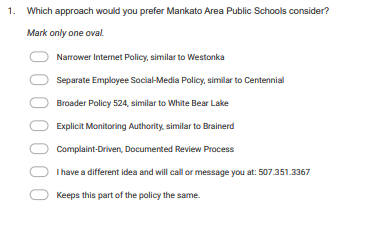
A — Narrower Internet Policy — similar to Westonka
Westonka Policy 5160 places its off-campus provision within the unacceptable-use section of its Internet, Technology, and Cell Phone Acceptable Use and Safety Policy. Its language focuses on unacceptable off-campus activity originating from a district-owned computer or resource. Westonka Public Schools
Possible benefit: Creates a clearer boundary between district technology and activity occurring entirely on privately owned technology.
Possible drawback: Some serious off-campus conduct using private technology could need to be addressed through another district policy rather than Policy 524 itself.
B — Separate Employee Social-Media Policy — similar to Centennial
Centennial Policy 430 — Employee Use of Social Media is separate from the district’s Internet-use policy. It specifically distinguishes rules applying during the duty day from employee social-media use outside the duty day. It also addresses when employees are speaking personally versus for the district and identifies conduct that may create a material and substantial disruption. Centennial School District
Possible benefit: Gives employees and administrators a dedicated policy explaining off-duty social-media expectations instead of placing those rules inside a general Internet-use policy.
Possible drawback: Having several related policies can make the rules harder to locate or understand unless the policies cross-reference each other clearly.
Centennial Policy 430 — Employee Use of Social Media
C — Broader Policy 524 — similar to White Bear Lake
White Bear Lake Policy 524 keeps off-campus conduct inside its Internet acceptable-use policy. It says users engaging in certain unacceptable Internet uses off school premises may violate the policy and allows the district to investigate reports originating from a non-school computer or resource. White Bear Lake
This is relatively similar to the approach currently used for MAPS.
Possible benefit: Gives the district one policy that can address serious online conduct affecting the school environment regardless of which device or Internet connection was used.
Possible drawback: Without very clear limits, employees and families may have questions about how far district authority extends into private accounts and off-duty activity.
D — Explicit Monitoring Authority — similar to Brainerd
Brainerd Policy 440 — Social Media Use is a separate employee policy. Its Section IV.F says publicly viewable personal Internet or social-media content is subject to district policies and that the district may view and monitor that content without prior consent or approval. Brainerd Public Schools
Possible benefit: Employees know explicitly what the district considers reviewable, rather than leaving monitoring authority ambiguous.
Possible drawback: Employees may view routine monitoring of their personal public accounts as overly broad or chilling legitimate private-citizen speech.
Brainerd Policy 440 — Social Media Use
E — Complaint-Driven, Documented Review Process
Another option is the framework contained in the legal draft I have been reviewing.
It would provide no routine monitoring of personal accounts. Instead, review would begin after a specific complaint or documented concern. The process would include documenting the complaint, determining the connection to school operations, applying a viewpoint-neutral standard, evaluating evidence of material disruption, distinguishing private-citizen speech from official-duty speech, and obtaining legal review before significant discipline. Off-Campus Social Media Policy.
Possible benefit: Creates a documented and predictable process while preserving the district’s ability to investigate legitimate concerns.
Possible drawback: A more formal process could require additional administrative and legal review and may take longer than broad discretionary authority.
Community Poll


Leave a comment