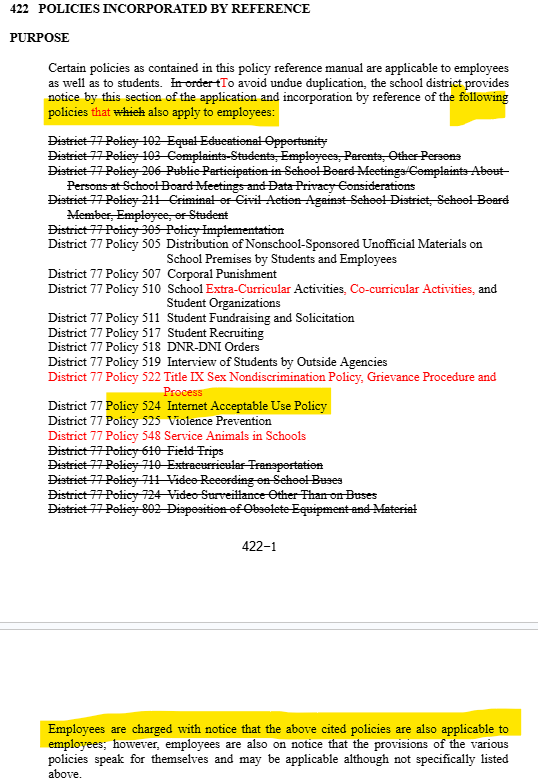
As part of our April 6th School Board meeting, we will be reviewing several policies, including Policy 422, which incorporates a number of district policies by reference; including Policy 524 (Internet Acceptable Use) and others that apply to both students and employees. This is a first reading.
These policies play an important role in defining expectations around behavior, communication, and the use of technology across our district. As I’ve reviewed them, I’ve been paying particular attention to how they work together, especially where policies overlap or may create unclear expectations for staff.
In some cases, policies addressing employee conduct, social media, and internet use appear to approach similar issues from different angles. One emphasizes professional judgment and guidance, while another outlines enforceable rules and disciplinary consequences. When combined under Policy 422, this raises important questions about clarity, consistency, and how these standards are applied in practice.
It also raises a broader concern that I think deserves thoughtful discussion:
- Where is the line between professional expectations and an employee’s right to free expression, especially outside of school?
When policies extend into off-campus behavior or use broad terms like “disruption” or “inappropriate,” it can create uncertainty. And when expectations are unclear, it may discourage open dialogue or make staff hesitant to share perspectives—even in appropriate settings.
Before casting my vote, I want to make sure I’ve heard from those most impacted.
* I’m specifically asking for your feedback:
- Do you feel these policies clearly define what is expected of staff?
- Do they respect appropriate boundaries between professional conduct and personal speech?
- Are there areas where the language could unintentionally limit open discussion or expression?
Your input matters, not just for this vote, but for ensuring we create a district culture where expectations are clear and people feel comfortable engaging in thoughtful, respectful dialogue.
| Category | Policy 471 – Social Media (Employees) | Policy 524 – Internet Use (Students & Employees) | Concern / Tension |
|---|---|---|---|
| Primary Purpose | Guidance on employee social media use and professional boundaries | Rules for acceptable use of district technology and internet systems | Overlap in regulating online behavior |
| Tone of Policy | Advisory (“should,” “consider,” “professional judgment”) | Directive (“will not,” defined violations, disciplinary consequences) | Unclear when guidance becomes enforceable |
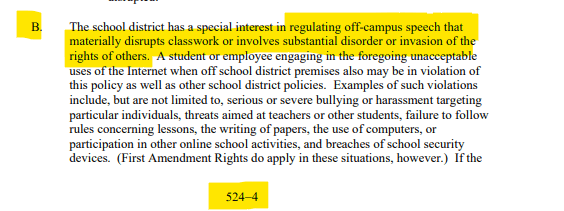
| Scope of Authority | Focuses on employee conduct, including personal social media | Applies to district devices, personal devices, and even off-campus behavior in some cases | Broad reach into personal life |
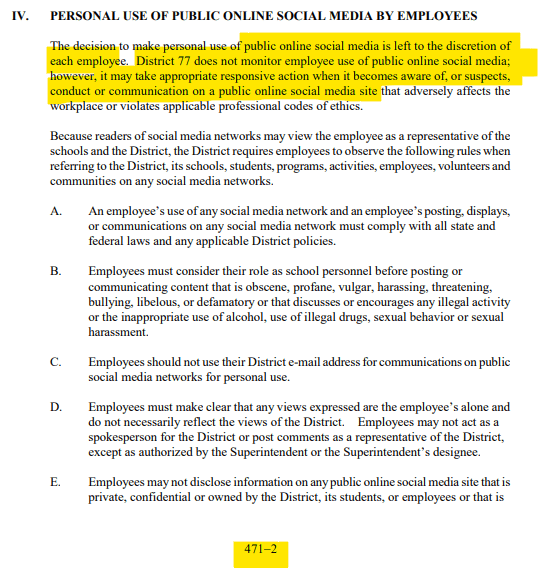
| Off-Campus Behavior | District does not monitor but may respond if issues arise | Explicitly allows discipline for off-campus conduct if it disrupts school | Conflicting expectations about private speech |
| Free Speech / Rights | Implies personal discretion but expects professionalism | Acknowledges First Amendment but allows discipline for “material disruption” | Risk of chilling effect due to unclear boundaries |
| Definition of Misconduct | Broad terms: inappropriate, unprofessional, poor judgment | Specific prohibitions + broad terms like “inflammatory,” “disrespectful” | Vague language allows subjective enforcement |
| Use of Personal Devices | Not a primary focus | Explicitly includes personal devices and networks in some cases | Expands district authority beyond school property |
| Monitoring & Privacy | States district does not actively monitor personal social media | States limited expectation of privacy and allows monitoring of systems | Tension between privacy expectations and oversight |
| Employee Role Online | Employees seen as representatives of the district | Focuses more on system use than identity | Blurs line between private citizen and employee |
| Student Interaction | Emphasizes maintaining appropriate boundaries | Focuses on safety, bullying, and communication rules | Alignment is partial but not clearly integrated |
| Disciplinary Consequences | Implied (can lead to discipline) | Clearly defined: loss of access, discipline, termination | Uneven clarity on consequences |
| Consistency with Other Policies | References other district policies broadly | Explicitly ties to multiple policies (bullying, data privacy, etc.) | Policy layering increases complexity |
| Policy 422 (Teacher Handbook) | Likely reinforces expectations of professionalism | Likely incorporates enforcement expectations | May amplify confusion rather than clarify |
🧠 Why Clarity Matters
When policies are clear, staff can:
- Confidently follow expectations
- Protect student privacy
- Engage in thoughtful, respectful dialogue
When policies are unclear or overlapping:
- Staff may hesitate to speak at all
- Important perspectives may go unheard
- Trust can erode both internally and within the community
Clarity benefits everyone.
Policy 422
Policy 524 page 4 section B
Policy 471 Page 2 number 4


Leave a Reply