Ahead of the April 6 School Board Meeting
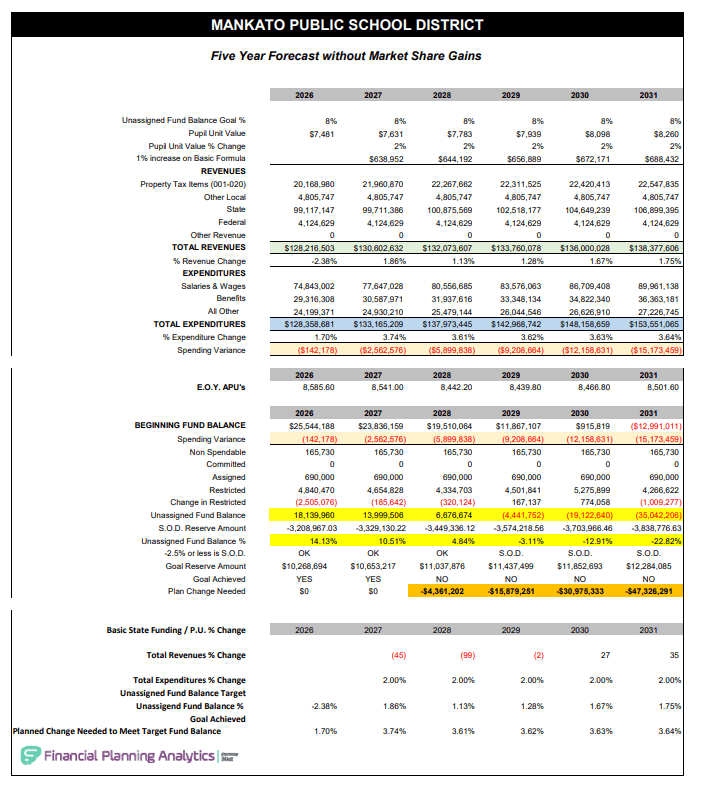
The district’s 5-year budget forecast is included within the referendum renewal materials that the School Board will be discussing on April 6.
Like many in our community, I don’t work in school finance every day. As a small business owner, I have to take the time to work through these documents carefully to understand what they actually mean.
If you’re interested, I encourage you to:
- Review the documents
- Ask questions
- Or participate in the public forum at the meeting
📄 View the Referendum Document
🧠 First—Understanding the Terms
One of the first things I had to look up was this line in the forecast:
“E.O.Y. APU’s”
If you’ve followed my previous posts, you’ve likely seen ADM used instead. These are similar, but not the same.
📊 ADM (Average Daily Membership)
- The actual number of students
- Adjusted for attendance
👉 Think: How many students do we serve?
⚖️ APU (Adjusted Pupil Units)
- A weighted version of students used for funding
- Based on grade level (older students generate more funding)
👉 Think: How much funding do our students generate?
💡 Why this matters
APU tells us how we’re funded. ADM tells us how many students we serve.
Both matter—and looking at only one can give an incomplete picture.
🧮 What Does “Plan Change Needed” Mean?
This is one of the most important lines in the entire document.
Plan Change Needed =
The adjustment required (through revenue, spending, or both) to return to the district’s 8% fund balance target
👉 It is not just the yearly deficit
👉 It shows how far we are from the target over time
📉 Breaking It Down Simply
The district has a policy to maintain:
👉 8% unassigned fund balance
That equals roughly:
- 2028 goal: ~$11.0M
- 2029 goal: ~$11.4M
- 2030 goal: ~$11.8M
- 2031 goal: ~$12.3M
📊 What the forecast shows
- 2028: $6.7M
- 2029: –$4.4M
- 2030: –$19.1M
- 2031: –$35.0M
🧠 What that means
Example (2028):
- Goal: $11.0M
- Actual: $6.7M
👉 Gap: –$4.36M
That gap is what shows up as:
Plan Change Needed: –$4,361,202
Example: 2031 (this is the big one)
- Goal: $12.3M
- Actual: –$35.0M
👉 Gap =
$12.3M – (–$35.0M) = $47.3M✔️ That matches:
–$47,326,291
💡 The key takeaway
This number doesn’t fix the trajectory—it shows how far we are from our target given our current path.
⚖️ Is 8% Required by the State?
No.
Minnesota does not require districts to maintain an 8% fund balance.
🚨 What the state actually requires
A district enters Statutory Operating Debt (SOD) when:
👉 Fund balance drops below –2.5%
At that point:
- The state requires a recovery plan
- Oversight increases
📊 So what is 8%?
👉 It is a local policy target
Districts choose targets like:
- 8%
- 10%
- 12–15%
Based on:
- Financial best practices
- Auditor recommendations
- Risk tolerance
🧠 Why fund balance matters
An 8% fund balance is roughly:
👉 About one month of operating expenses
It helps districts:
- Handle unexpected costs
- Manage enrollment changes
- Maintain stable operations
- Protect financial standing
📉 What the forecast shows
From the current projection:
- Falls below 8% by 2028
- Turns negative by 2029
- Reaches –22.8% by 2031
🎯 What that means
- 8% = early warning
- –2.5% = state intervention
- The forecast crosses both
💰 Fund Balance: From Healthy to Concerning
The district sets a goal to maintain an 8% fund balance (a financial safety cushion).
Here’s what the forecast shows:
- Today: ~14% (healthy)
- 2028: falls below target
- 2029+: turns negative
- 2031: about –22.8%
👉 Translation:
Without changes, reserves are eventually exhausted and the district enters statutory operating debt.
🧠 Final Thought
Financial documents like this can be difficult to interpret—but they are critical to understanding the decisions in front of us.
This forecast is not a final outcome. It is a projection based on current assumptions.
But it does highlight something important:
Without changes, the current financial path is not sustainable.
📣 Invitation
If you have questions or thoughts, I encourage you to:
- Attend the April 6 meeting
- Participate in public comment
- Or continue the conversation in the community


Leave a Reply