Reflections from the Leadership Institute
By ElizaBeth Hanke
I attended the Leadership Institute this fall and came home with a notebook full of ideas and a question that connected nearly every session: Do we fully understand the authority and responsibility we have as school board members?
The presentations covered school finance, legal authority, academic achievement, superintendent evaluations, classroom discipline, and transparency. A panel featuring Tanya Price, Kyle Christianson, and Carrie Tate added practical lessons from their own board experiences.
What follows is a reflection on what I learned and the questions I believe are worth discussing here in Mankato. These are my personal observations and ideas for consideration. They do not represent decisions or positions adopted by our board.
Understanding the Board’s Role
Jody Withers’ presentation on school board authority encouraged me to spend more time reading the laws that define our responsibilities.
Two important starting points are Minn. Stat. 123B.09, which places the care, management, and control of independent school districts with the school board, and Minn. Stat. 123B.02, which describes the board’s general authority, including implied powers alongside those specifically granted by the Legislature.
That authority belongs to the board acting collectively. Understanding it should help us ask better questions, give clearer direction, and take responsibility for the decisions entrusted to us.
Our Policy 216 — Legal Counsel provides for appointing counsel to represent the district and advise the board. It also expressly allows the board to seek legal counsel from other sources when it considers that advisable. One question I brought home concerns how we use that authority. How does the board obtain advice about its own authority, responsibilities, and relationship with administration?
Supporting Teachers and Protecting Learning Time
As we review Policy 506 — Student Discipline, the sessions raised timely questions about classroom behavior.
Minn. Stat. 121A.61 requires a districtwide discipline policy addressing student conduct, consequences, classroom removal procedures, and a complaint process. Minn. Stat. 122A.42 also recognizes teachers’ classroom authority and permits removal for violent or disruptive conduct under the referenced statutory procedures.
My question is whether our policies give teachers clear, usable tools and dependable administrative support.
What happens when disruption continues? Who responds when a teacher needs help? How are parents informed? What support does a student receive before returning to class? How do we protect the learning of the other students affected?
Our Policy 539 — Eligibility and Training Rules already addresses activity eligibility and penalties for specified violations. I believe we should review how those rules address serious misconduct and whether changes are needed. Any proposal would need careful review of applicable law, district procedures, and Minnesota State High School League requirements.
The questions include consistency, proportional consequences, an opportunity to respond, and a clear path back to participation. Activities can provide valuable connections for students, and those benefits should be part of the discussion.
Looking Closely at Academic Results
Another presentation challenged board members to understand what achievement measures actually tell us.
The slides compared state assessments, national assessments, and college-readiness results. My takeaway was the importance of looking beyond a headline percentage and asking what it measures.
Which students participated? What standard defines proficiency? Are we comparing similar groups? Have the assessment or its benchmarks changed?
I want our board to understand both student growth and whether students are reaching the knowledge and skills expected at their grade level. We also need to see where district averages may hide students who need more help or greater academic challenge.
Families deserve information they can understand, and board members need enough detail to judge whether our investments are improving learning.
Keeping Our Mission Connected to Our Budget
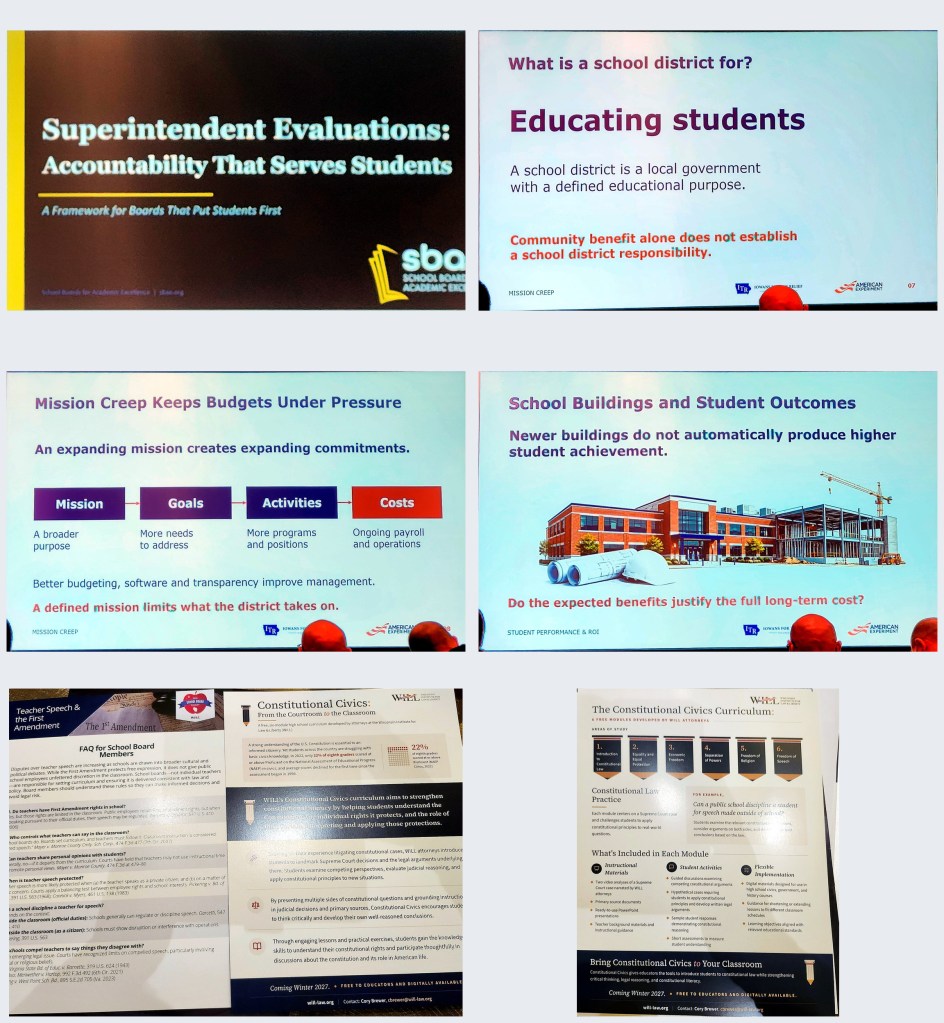
Sarah Curry of the Iowans for Tax Relief Foundation discussed school finance and “mission creep,” the gradual expansion of an organization’s responsibilities and commitments.
Her presentation illustrated how a broader mission can lead to more goals, additional programs and positions, and continuing payroll and operating costs.
That made me think about the questions we should ask when considering any new initiative:
- What student need are we addressing?
- How does this support learning?
- What will it cost after the initial funding ends?
- How will we know whether it works?
- When will we review whether it should continue?
Students bring many needs to school, and meeting those needs can be essential to their education. The board’s responsibility is to understand the purpose, results, and long-term cost of the commitments we make.
The enrollment presentation reinforced this point. Using examples from Iowa; it showed why enrollment trends should shape decisions about staffing, programs, and facilities.
For Mankato, the useful question is how our own enrollment projections should inform the commitments we make today. We should understand the size and needs of the student population moving through our schools, along with existing committments.
Making Superintendent Evaluations Meaningful
The superintendent evaluation session connected leadership accountability directly to student outcomes. Our Policy 304 — Superintendent Contract, Duties and Evaluation requires an annual evaluation using a board-approved performance appraisal instrument developed in consultation with the superintendent.
The presentation emphasized criteria established in advance, measurable goals with clear starting points and targets, academic evidence, and information from multiple sources.
That approach appeals to me because it gives both the board and superintendent a shared understanding of success.
A thoughtful evaluation should recognize the complexity of leading a district while examining whether the organization is making progress. Academic achievement, financial stewardship, implementation of board priorities, and community trust all deserve careful consideration.
Reviewing How the Board Governs Itself
The conference also prompted questions about the policies that govern our own work.
For Policy 209 — Code of Ethics, I would like us to consider whether clear operating norms could better explain how we agree to work together. Those norms could address meeting preparation, access to information, respectful disagreement, and the distinction between an individual member’s views and an official board position.
We should also examine how the policy addresses speech outside meetings. Board members need room to explain their reasoning, raise concerns, and disagree publicly while meeting their legal obligations.
For Policy 208 — Development, Adoption, and Implementation of Policies, understanding which procedures come from law and which reflect choices made by our board is key.
The posted policy generally provides for final action at a later meeting after a proposal is introduced and public input is received. It also includes emergency procedures, a process for minor technical revisions, and a one-meeting option for revisions required by a legal change over which the board has no control. Public access to proposed language and a meaningful opportunity to understand changes should remain central to that discussion.
Exploring Innovation and Understanding State Requirements
Minnesota’s education innovation statutes, Chapter 124F, include provisions addressing innovation research zones, experiential learning, career and technical education, and other learning opportunities. I would like us to examine which options might fit our students and what their requirements would be.
A useful first step would be identifying a specific student need, then investigating whether an available pathway could help meet it.
The conference also reinforced the value of asking for the legal basis behind state requirements. When we are told a proposal cannot move forward, we should ask which statute, rule, or other binding requirement establishes that limit.
Minn. Stat. 14.05 requires agency rulemaking to rest on authority delegated by law. Understanding the source of a requirement can help us distinguish legal obligations from guidance and identify where local choices remain available.
Making Detailed Board Work Easier to Follow
One of the most practical sessions addressed committees and work sessions.
Our Policy 214 — School Board Committees already establishes standing committees for communications, executive matters, facilities, finance, and policy. It also permits ad hoc committees and makes clear that committees advise the full board, which retains final decision-making authority.
I would like us to consider how effectively our existing committees support detailed review and whether a teaching and learning committee would add value. Each committee needs a clear purpose, defined responsibilities, and a reliable way to report back.
Transparency must be part of that work. Our Policy 205 — Open Meetings and Closed Meetings is another relevant local reference. Minnesota’s Open Meeting Law generally covers school boards and their committees, with exceptions established by law. The presentation also reminded attendees that discussion and information gathering can raise open-meeting requirements even when no vote occurs.
My goal would be to make the development of recommendations easier for the public to follow. Accessible schedules, agendas, materials, and records would help community members understand how an issue reaches the full board.
Reviewing Union Contract Language
The labor-law presentation raised a specific local concern: a slide identified a fair-share-fee provision in Mankato’s 2024–2026 Educational Secretaries agreement. The provision described requiring nonmembers to contribute fees and having those fees deducted from their salaries.
The Supreme Court’s 2018 decision in Janus v. AFSCME prohibits collecting compulsory public-sector union fees from nonconsenting employees. I have since confirmed that Article V, Section 4, on page 9 of the current 2026–2028 agreement retains this language. Its presence alone does not establish that unauthorized fees have been collected. I would like the district to explain whether the provision has been treated as unenforceable, how payroll deductions are authorized, and how the language can be corrected. We should ensure our contracts accurately explain employees’ rights and that our practices follow current law.
Bringing the Learning Home
The conference materials also introduced a forthcoming constitutional civics curriculum from the Wisconsin Institute for Law & Liberty. The handout described lessons built around Supreme Court cases, primary sources, competing arguments, and students developing their own reasoned conclusions.
That caught my attention because understanding authority and evaluating evidence matter both in the classroom and at the board table.
I appreciate the opportunity to learn from presenters and fellow board members. Now I would like to bring those ideas into thoughtful, public discussion here at home.


Leave a Reply