By Elizabeth Hanke
08/31/2026
Minnesota State University, Mankato has a Civil Engineering program with roughly 165 students preparing for careers in roads, bridges, water systems, utilities, public infrastructure and private development.
Yet at the same time Minnesota continues to need engineers in these fields, MNSU’s Civil Engineering program has experienced significant faculty reductions and fewer course options for students.
That raises an important question:
How small can the faculty become before students begin losing the educational opportunities they were promised?
A Comparison Worth Examining
One useful comparison is South Dakota Mines.
According to the most recent numbers available to me, the undergraduate Civil Engineering programs at MNSU and South Dakota Mines are remarkably similar in size.
| Minnesota State Mankato | South Dakota Mines | |
|---|---|---|
| Undergraduate Civil Engineering students | approximately 160–170 | 185 |
| Approximate CE/CEE faculty | 4 faculty lines going forward | approximately 9–10 |
| Undergraduate students per faculty position | roughly 40–42:1 | roughly 19–21:1 |
South Dakota Mines’ Fall 2025 public dashboard showed 52 freshmen, 38 sophomores, 31 juniors and 64 seniors in Civil Engineering, for a total of 185 undergraduate students.
MNSU’s recent Civil Engineering enrollment has been approximately 160–170 students.
The difference in enrollment is relatively small.
The difference in faculty depth appears much larger.
MNSU Civil Engineering has gone from approximately seven faculty positions to four. With one faculty member expected to be on sabbatical during the 2026–27 academic year, that may leave only three Civil Engineering faculty members available to teach during that period.
South Dakota Mines, by comparison, appears to have approximately nine to ten faculty directly supporting Civil and Environmental Engineering, with expertise in areas including structural, geotechnical, water resources, environmental engineering and materials.
South Dakota Mines is also supporting graduate education.
Faculty workload, research responsibilities and university structures certainly differ between institutions, so faculty headcounts alone cannot tell the entire story.
But a difference this large deserves examination.
Students Are Already Seeing the Impact
The concern is not simply how the numbers look on paper.
Students are experiencing fewer course choices, particularly as they move into upper-level Civil Engineering coursework.
There were courses approaching the beginning of the Fall 2026 semester that still did not have instructors assigned.
Civil Engineering students are also required to take technical electives. Traditionally, those electives allow students to explore specialties such as structural engineering, transportation, geotechnical engineering, water resources or environmental engineering.
But when only one technical elective is available, an “elective” stops being much of a choice.
Students lose the opportunity to explore different areas of the profession and prepare for the specialties they hope to pursue after graduation.
That can also create concerns for recruitment and retention. Students comparing engineering programs are not simply looking at whether a major exists in the university catalog. They are looking at the professors, course options, laboratories, specialties and opportunities available once they arrive.
What Should Minnesota State Be Asking?
Before these faculty reductions become the permanent structure of the program, Minnesota State and MNSU leadership should conduct a serious review.
That review should include:
- Comparing MNSU Civil Engineering staffing, teaching loads and course offerings with peer ABET-accredited programs of similar enrollment.
- Reviewing the number of upper-level Civil Engineering courses and technical electives actually offered each semester, rather than simply counting courses appearing in the catalog.
- Determining whether three or four faculty positions can reasonably provide approximately 160 students access to structural, geotechnical, transportation, water/environmental and other core areas of Civil Engineering.
- Examining faculty teaching loads and the number of different course preparations being required of the remaining faculty.
- Evaluating the potential impact on recruitment, retention and students transferring to other universities.
- Examining whether reduced faculty depth or course availability could create concerns during future ABET accreditation reviews.
- Publicly explaining the university’s long-term plan for maintaining and growing Civil Engineering under the current staffing model.
These are reasonable questions for students, employers, alumni and taxpayers to ask.
Minnesota Needs Civil Engineers
Higher education institutions across Minnesota are facing real financial pressures, and difficult decisions will inevitably have to be made.
But those decisions should also reflect workforce needs.
Civil engineers design and maintain many of the systems communities depend upon every day: roads, bridges, drinking water systems, wastewater treatment facilities, stormwater systems, utilities, buildings and other critical infrastructure.
These are not disappearing professions.
They are precisely the kinds of skilled graduates Greater Minnesota needs its regional universities to produce.
That is why reducing faculty in a program with approximately 165 students actively choosing Civil Engineering seems counterintuitive.
Instead of asking how few faculty members are required to keep the program operating, Minnesota State should be asking:
What does MNSU need to build a Civil Engineering program that students actively choose over competing universities?
South Dakota Mines provides an important comparison.
If a Civil Engineering program with 185 undergraduate students can maintain substantially greater faculty depth and course opportunities, Minnesota State should explain why a program with roughly 160 students in Mankato cannot do something similar.
A strong Civil Engineering program should offer students more than the minimum courses necessary to earn a degree.
It should give them the opportunity to explore specialties, learn from faculty with different areas of expertise, participate in meaningful projects and graduate prepared to build the infrastructure Minnesota will depend upon for decades.
MNSU has students who have already chosen Civil Engineering.
The goal now should be to give them a program worth staying for, and to build one that future students will continue to choose.
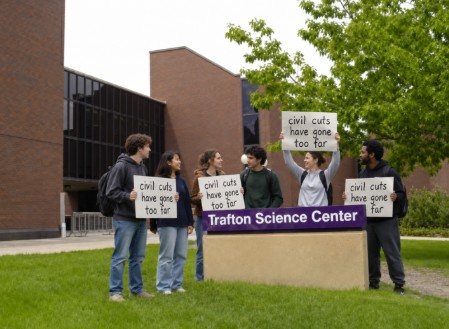
*The photo is AI generated and the students in the photo are not students at MNSU


Leave a Reply