The Mankato Free Press recently reported that the Mankato Area Public Schools Board is optimistic about the district’s 2026-27 budget. While there is certainly good news in the budget, there are also long-term challenges that deserve continued attention.
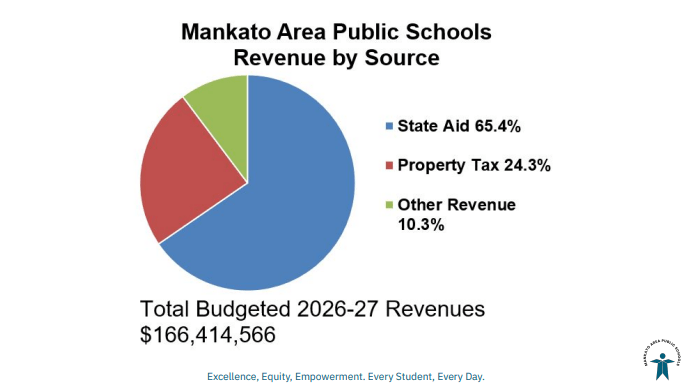
The preliminary budget projects approximately $166.4 million in revenue and $167.8 million in expenditures across all operating funds. The district attributes much of the expenditure growth to employee contracts, health insurance costs, transportation expenses, and increased debt payments associated with recent building projects.
The Good News
The district remains in a financially stable position.
The General Fund unassigned balance is projected to end FY27 at approximately $16.3 million. According to district documents, that represents about 45 days of operating expenses and roughly 12.3% of annual expenditures. This exceeds the district’s board policy goal of maintaining reserves equal to at least 30 days, or 8% of expenditures.
This reserve provides important flexibility when unexpected expenses arise or when state funding changes.
The Challenge: Costs Continue to Rise
While revenues continue to increase, expenditures are increasing as well.
The district’s own budget narrative notes that Minnesota’s education funding formula has struggled to keep pace with inflation and rising operational costs. Employee wages, benefits, utilities, instructional materials, transportation, and health insurance all continue to put pressure on school district budgets across the state.
In addition, uncertainty remains around future compensatory revenue funding. The district specifically identifies this as a concern moving forward.
To help address these challenges, the FY27 budget includes approximately $1.8 million in adjustments and reductions.
The Question That Matters Most: Enrollment
Perhaps the most important sentence in the budget is not about revenues or expenditures.
It is this:
“Enrollment continues to be a critical component of the revenue budget. With birth rates declining in the region, we are projected to continue to see a slight decline in our enrollment over the next five years.” Appears on page 4. Also, the district notes, “Enrollment: Expected to slightly decline from FY26.” (page 12).
This matters because state aid is largely driven by student enrollment.
As a community, we should be asking:
- Why are families choosing other educational options?
- What can be done to attract and retain students?
- How can district programs better meet family needs?
These are not criticisms. They are simply the questions that every district facing enrollment decline must address.
Understanding the Taxpayer Impact
Property tax revenue continues to increase and now represents approximately 24.3% of district operating revenue. State aid remains the largest source at approximately 65.4%.
Over the past five years:
- Property tax revenue increased from approximately $28.3 million in FY23 to $40.4 million in FY27.
- State revenue increased from approximately $89.9 million to $108.9 million.
- Total district operating revenue increased from approximately $136.2 million to $166.4 million.
Many of these increases are connected to voter-approved facility projects and state funding changes.
Looking Beyond One Budget Cycle
The district deserves credit for presenting a balanced budget while maintaining reserve levels above policy requirements.
However, the long-term conversation should not end with whether FY27 balances.
The larger questions are:
- Can enrollment stabilize?
- Can state funding keep pace with inflation?
- Can the district continue maintaining facilities without increasing financial pressure?
- How will future debt obligations affect taxpayers?
- Will current reserves be sufficient if enrollment declines continue?
These are not problems unique to Mankato. School districts throughout Minnesota are wrestling with many of the same issues.
The FY27 budget suggests the district is stable today. The challenge for the board, administration, staff, and community will be ensuring that stability remains five and ten years from now.


Leave a Reply