I recently sat down with the Mankato Area Public Schools Annual Comprehensive Financial Report (ACFR), attached below.
At more than 140 pages, it’s not exactly light reading.
Most people. including me, would never read every page. So I asked myself a simple question:
If I could only print a handful of pages, which ones would tell the most important story about the district’s financial future?
After working through the report, I settled on seven pages; 23, 120, 125, 126, 127, 128, 132.
What I found wasn’t necessarily alarming, but it was thought-provoking.
The First Thing That Stood Out: Enrollment
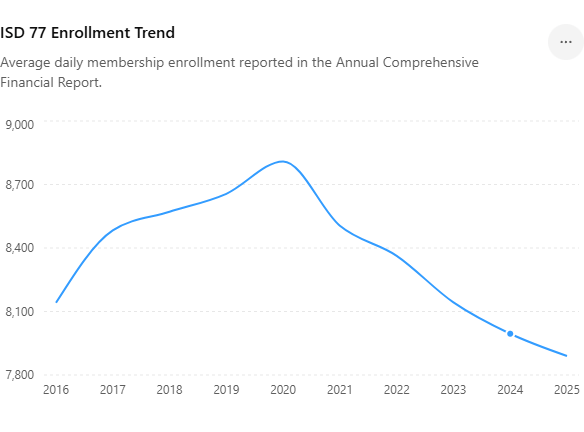
One of the most important statistics for any school district is enrollment. See page 23 of document of ACFR.
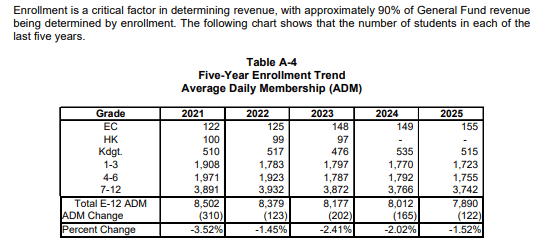
The district is serving about 10.4% fewer students than it did in 2020.
Enrollment peaked at 8,809 students in 2020.
Enrollment declined to 7,890 students in 2025.
That’s a loss of 919 students in five years. This number also includes (EC) Early Childhood. When getting numbers from the demographic booklet, the numbers are generally K-12.
While the Mankato area’s population grew from 41,727 residents in 2016 to 45,742 residents in 2024, district enrollment moved in the opposite direction. Enrollment increased through 2020 before beginning a multi-year decline that continues today. This is important because enrollment drives a large share of state education funding and influences long-term staffing and facility decisions.
The Second Thing That Stood Out: Debt
The district’s debt story is interesting.
From 2016 through 2020, debt steadily declined as older bonds were paid off.
Then came the 2023 bond referendum.
The report shows total district debt increasing from approximately $119 million in 2023 to more than $225 million in 2024.
By 2025, debt had fallen slightly to about $215 million as payments began reducing principal.
This isn’t surprising. Bond referendums are intended to finance large projects over many years.
The question isn’t whether debt exists.
The question is whether the debt remains sustainable as enrollment changes.
The number I think is most revealing
Debt per capita
This asks:
How much district debt exists for each resident in the district?
| Year | Debt per capita |
|---|---|
| 2016 | $2,372 |
| 2020 | $1,554 |
| 2023 | $1,995 |
| 2024 | $3,759 |
The “Per Capita” column on Page 120 is:
For 2024:
- Total debt = $225.6 million
- Population = about 60,017
That’s where the report’s $3,759 per capita comes from.
One number I wish the report tracked is debt per student.
Using the district’s own numbers, outstanding debt at the end of fiscal year 2025 was approximately $215 million.
Enrollment was approximately 7,890 students.
How much principal and interest are taxpayers paying each year for each student?
Formula:
Example:
If annual debt payments were $18 million and enrollment was 7,890:
That would mean taxpayers are spending about $2,282 per student each year just on debt repayment.
This is often more important than total debt because it shows the annual budget impact.
Again, this isn’t an official accounting metric.
But it helps put debt into context.
Why I focused on these Seven pages
I didn’t focus on these pages because they support a particular agenda.
I printed them because they raise important questions.
- Why is enrollment declining?
- How should we evaluate debt relative to enrollment?
- What financial indicators should the community monitor?
- What does long-term sustainability look like?
The annual report contains hundreds of numbers.
These six pages helped me focus on the handful of questions that matter most.


Leave a Reply