Mankato Area Public Schools recently announced its summer breakfast and lunch program, which raised good questions from community members about how these programs are funded, how reimbursement works, and how the summer model differs from the regular school-year meal program.
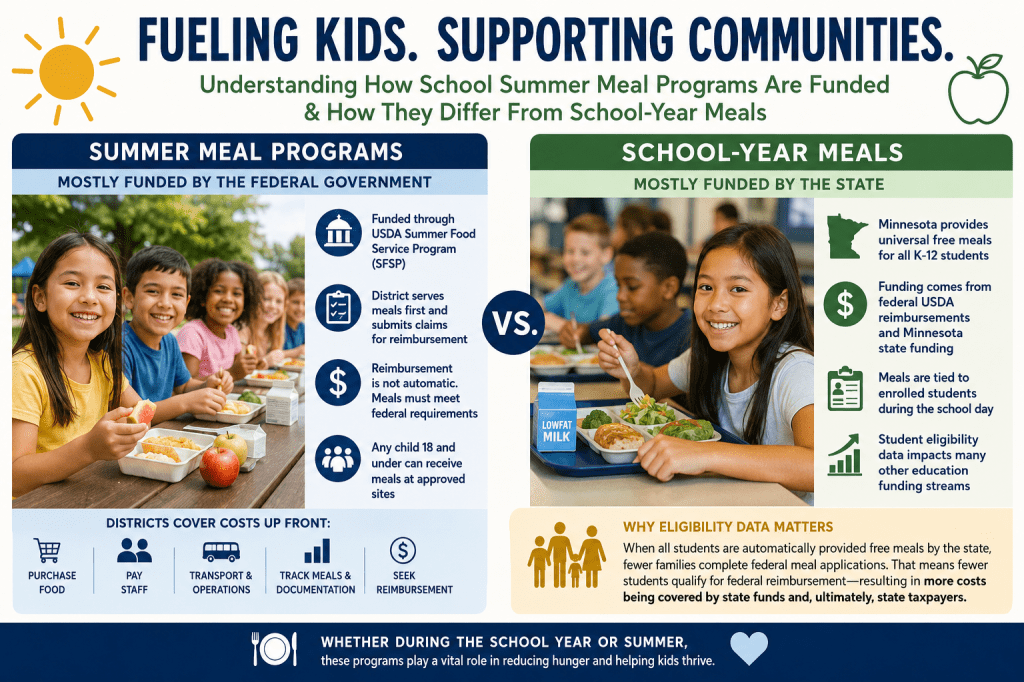
One important distinction is that Minnesota’s school-year meal program is now largely supported through a combination of federal funding and significant state funding, while summer meal programs rely much more heavily on federal USDA reimbursement programs.
During the School Year
Minnesota currently operates under a universal free school meals model for K-12 students.
Funding comes from:
- Federal USDA reimbursements
- Minnesota state funding
Meals are tied directly to enrolled students during the educational day.
Schools use student accounts and integrated meal tracking systems. Student eligibility data is still collected because it affects many other education funding streams.
One challenge with universal meal programs is that when all students automatically receive free meals through the state, some families may feel there is little reason to complete the federal free-and-reduced meal application process. Historically, those applications helped districts qualify for additional federal reimbursements and other federally connected funding streams.
If fewer families complete those applications, districts can lose access to portions of federal support tied to income qualification data, which can shift a larger share of long-term meal costs and related program funding onto Minnesota taxpayers and state and local funding sources.
The school-year system is relatively stable because:
- Participation is predictable
- Staffing is already in place
- Buildings are already operating
- Transportation systems already exist
- Meal service is integrated into daily school operations
During the Summer
The summer program operates more like a temporary community feeding program.
Key differences include:
- Any child 18 and under may participate
- Children may not attend the district
- IDs are often not required
- Participation fluctuates significantly
- Sites must independently qualify
To receive USDA reimbursement, districts generally must comply with rules regarding:
- Nutrition standards
- Approved serving times
- Accurate meal counting
- Proper documentation
- Site eligibility requirements
- Federal program compliance
If meals are served outside the approved rules, reimbursement can be denied.
That means districts still carry some financial risk. If some meals are not reimbursed, the district must absorb those costs through other funding sources.
Those costs may come from:
- The district food service fund
- State nutrition grants
- Local partnerships or nonprofits
- Foundation support
- Community donations
- Other district resources
Even when meals fully qualify, districts can still face financial pressure if food, labor, transportation, or operational costs rise faster than reimbursement rates.
Resources:
https://www.fns.usda.gov/summer -Explains how the federal summer meals program works and who qualifies.
https://www.fns.usda.gov/summer/sunmeals/reimbursement-rates -Federal reimbursement rates for summer meals programs.
https://education.mn.gov/MDE/dse/FNS/SNP/free -Minnesota’s state-funded universal school meals program overview.
https://education.mn.gov/MDE/dse/FNS/CLiCS/058234 – Explains how schools submit reimbursement claims and why meal eligibility tracking matters.
https://www.fns.usda.gov/schoolmeals/reimbursement-rates – Current federal reimbursement rates for school-year breakfast and lunch programs.
Elizabeth Hanke
I am a member of the Mankato Area School Board. I wrote this article to better help my constituents understand funding and policy. Any opinions are my own and not a representation of the district.


Leave a Reply