
FY 2026-27 Budget Recommendation for MN Department of Education
Or Link:
📌 Core Budget Change Items & Where to Find Them
(These are major proposals or policy changes the Governor is recommending.)
Fraud Detection and Prevention
Longer Synapsis Click Here
Short synopsis:
Strengthens financial oversight and fraud detection mechanisms within education funding systems, emphasizing prevention, monitoring, and accountability rather than new penalties or program cuts.
What this means for Mankato Area Public School (MAPS):
- Likely increased documentation, internal controls, or audit expectations.
- No direct funding change, but potential administrative workload increase.
- Districts with strong existing financial controls should see minimal disruption.
Compensatory Revenue Modification
Short synopsis:
Modifies how compensatory education aid is calculated for schools serving higher-need students, adjusting formulas to better align with updated poverty indicators.
What this means for MAPS:
- MAPS’ compensatory revenue could increase or decrease depending on how its student poverty measures compare under the revised formula.
- Shifts funding emphasis from legacy metrics to updated demographic indicators.
- Requires district review once final allocations are released.
Additional Unemployment Insurance Aid for Hourly Workers
Short synopsis:
Provides additional UI-related support to prevent districts from having to shift unemployment insurance costs into other education funds, including special education.
What this means for MAPS:
- Reduces risk that MAPS would need to backfill UI costs from special education budgets.
- Improves budget predictability during layoffs or staffing transitions.
- Beneficial if MAPS has significant hourly or seasonal staff exposure.
Tribal Contract Schools Eligible for Grant Funding
Short synopsis:
Clarifies statute so Tribal contract schools are explicitly eligible for state education grants wherever districts and charters are eligible. No new funding is created.
What this means for MAPS:
- Competitive grants may include additional eligible applicants.
- No change to MAPS formula aid.
- Potential opportunities for collaboration with Tribal schools.
Clarify Minnesota Indian Teacher Training Program Fund Uses
Short synopsis:
Clarifies allowable uses of MITTP funds to ensure alignment with K–12 educator preparation and support.
What this means for MAPS:
- Greater clarity for MAPS if partnering with higher education institutions on teacher pipeline efforts.
- Helps ensure program dollars remain focused on K–12 staffing needs.
Service to Success Initiative
Short synopsis:
Creates or expands a statewide initiative connecting service opportunities, grants, and education pathways to support student success and workforce development.
What this means for MAPS:
- Potential access to service-based supports (tutoring, mentoring, student engagement).
- Participation may require staff coordination and supervision capacity.
- No guaranteed funding without successful participation or grants.
Literacy Incentive Aid Formula Change
Short synopsis:
Changes the Literacy Incentive Aid formula by reducing reliance on test-based measures and increasing emphasis on poverty data; overall funding is redistributed, not increased.
What this means for MAPS:
- MAPS could gain or lose LIA depending on its poverty metrics relative to prior MCA-based outcomes.
- Shifts incentives toward need-based allocation rather than performance growth alone.
- Requires district-specific modeling to assess net impact.
Transfer Collaborative Urban and Greater Minnesota Educators of Color Grant
Short synopsis:
Transfers administration of the Educators of Color grant from PELSB to MDE for centralized oversight; funding levels remain unchanged.
What this means for MAPS:
- Same grant dollars, but new administrative processes and timelines.
- Potential for more consistent technical assistance under MDE.
Transfer Teacher Mentorship and Retention Grants to MDE
Short synopsis:
Moves teacher mentorship and induction grants from PELSB to MDE to streamline educator workforce supports.
What this means for MAPS:
- Application and reporting processes may change.
- If MAPS participates, mentoring supports continue but under MDE administration.
Student Support Personnel Aid Allowable Uses Modified & Rename Student Support Personnel Pipeline Grant Program
Short synopsis:
Expands allowable uses of Student Support Personnel Aid when districts face staffing shortages and renames the “pipeline” grant to “pathway” for cultural responsiveness. Cost neutral.
What this means for MAPS:
- Greater flexibility to use aid for retaining staff, training, coaching, or evidence-based materials when hiring is difficult.
- Helpful amid workforce shortages or enrollment-driven staffing pressures.
Clarify Lease Levy Authority
📄 Page 51
Short synopsis:
Clarifies statutory definitions and approval criteria for education lease levies without changing per-pupil levy authority amounts.
What this means for MAPS:
- Clearer guidance if MAPS uses or considers lease levies for facilities.
- May introduce additional review requirements for certain lease types.
- No new revenue created.
Modify Achievement and Integration Program and Administration
📄 Page 53
Short synopsis:
Adjusts A&I program administration, increasing MDE’s technical assistance capacity by reallocating a larger administrative set-aside within existing funds.
What this means for MAPS:
- MAPS receives A&I funds, and a smaller portion may be redirected to administration.
- Potential benefit: improved support, faster plan approval, clearer guidance.
Modify Allowable Uses for Nonprofit Food Service Expenditures & Repurpose Summer Food Service Program
📄 Page 58
Short synopsis:
Tightens allowable uses of nonprofit food service accounts and repurposes SFSP incentive dollars to support Summer EBT data administration. Cost neutral.
What this means for MAPS:
- More restrictive accounting rules for food service expenditures.
- Potential general fund exposure if food service deficits occur.
- Small but more meaningful compensation for S-EBT administrative work.
Legal Services Costs & Operating Adjustments
Short synopsis:
Provides one-time funding for MDE legal costs and ongoing operating adjustments to address inflationary pressures; applies to agency operations, not district aid.
What this means for MAPS:
- No direct funding impact.
- Indirectly may improve responsiveness in disputes, rulemaking, and compliance guidance.
Administrative Alternatives to Department of Children, Youth and Families
📄 Page 68
Short synopsis:
Aligns administrative and fiscal authorities for programs transferring from MDE to the new Department of Children, Youth, and Families. Budget neutral.
What this means for MAPS:
- Early childhood and family-facing programs may have new administrative pathways.
- Payment schedules and service continuity are preserved.
Reduce Special Education Transportation Reimbursement
📄 Page 70
Short synopsis:
Reduces the percentage of special education transportation costs reimbursed by the state, producing significant statewide savings.
What this means for MAPS:
- Likely increases local financial responsibility for special education transportation.
- May worsen cross-subsidy pressures.
- Limited flexibility due to IEP and FAPE requirements.
Eliminate Alternative Teacher Compensation Revenue (Q Comp)
📄 Page 72
Short synopsis:
Eliminates Q Comp beginning FY 2027 after a transition year, reducing both state aid and associated local levy authority.
What this means for MAPS:
- MAPS participates in Q Comp, this represents a significant revenue loss starting FY27.
- Requires transition to TDE-only systems and possible renegotiation of compensation structures.
Eliminate Nonpublic Pupil Education and Transportation Aid
Short synopsis:
Eliminates state aid and district obligations for nonpublic pupil educational materials, services, and transportation.
What this means for MAPS:
- MAPS would no longer be required to provide or administer these services.
- Budget impact depends on current level of nonpublic participation.
- Potential community and parent impact, but reduced district operational responsibility.
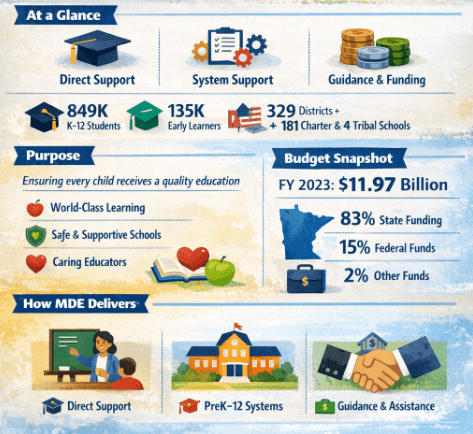
At a Glance
The Minnesota Department of Education (MDE) supports Minnesota’s education system through three core functions:
- Direct Support: Helping schools, educators, students, and families improve teaching and learning.
- System Support: Developing education policy, programs, and accountability systems.
- Guidance, Technical Assistance, and Funding: Providing direction, compliance support, and administering state and federal education funds.
Who MDE Serves (2023)
- ~850,000 K–12 students
- 135,000+ early learners
- 329 school districts, 181 charter schools, and 4 tribal schools
- 47,600 adult learners
Purpose
MDE’s mission is to ensure every child receives a quality education, regardless of race or zip code. Its work focuses on:
- World-class learning opportunities
- Safe, supportive school environments
- Caring, qualified educators
- Strong partnerships with schools and libraries statewide
Budget Snapshot
In FY 2023:
- 83% of education funding came from the state general fund
- 15% from federal sources
- 2% from other funds
Total spending was $11.97 billion, with:
- $11.81B passed through as aids and grants to schools
- $99.5M for operations
- $51.8M for employee compensation

 Elizabeth Hanke for Mankato School Board
Leave a reply to Eliminate Nonpublic Pupil Education Aid – Elizabeth Hanke for Mankato School Board Cancel reply