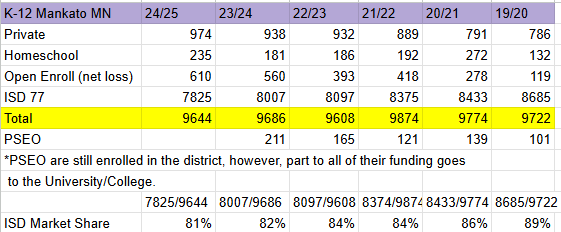
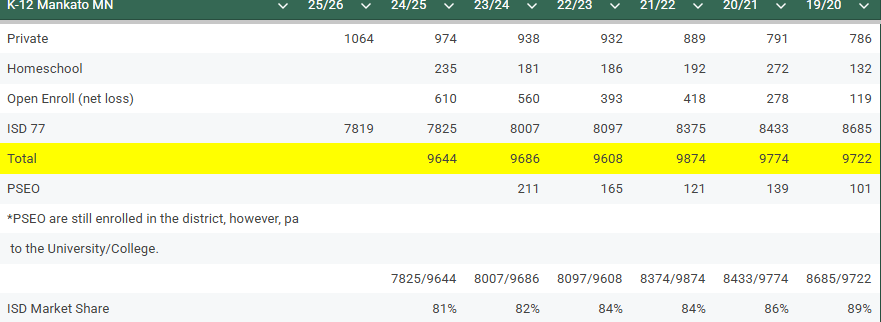
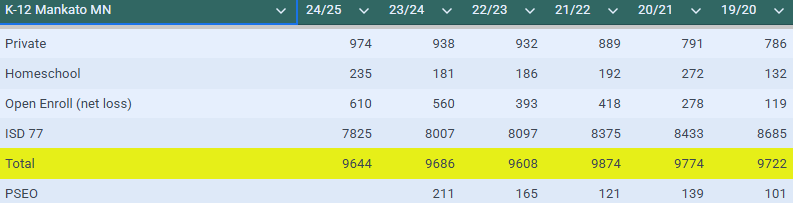
Mankato’s K-12 student landscape shows shifting dynamics from 2019-20 to 2024-25. Total potential students (public, private, homeschool, open enrollment) hover around 9,600–9,900, peaking at 9,874 in 2021-22. ISD 77 (Mankato Area Public Schools) enrollment, however, declined from 8,685 in 2019-20 to 7,825 in 2024-25—a 10% drop. Private school enrollment rose steadily, from 786 to 974 (+24%), while homeschooling fluctuated, spiking to 272 in 2020-21 (pandemic peak) before settling at 235. Open enrollment losses grew significantly, from a net loss of 119 students in 2019-20 to 610 in 2024-25, signaling more families choosing nearby districts. PSEO (Post-Secondary Enrollment Options) participation also climbed, from 101 students in 2019-20 to 211 in 2023-24, reflecting growing interest in earning college credits.
The closure of Kato Public Charter School at the end of the 2024-25 school year, after serving around 90 students, will further reshape the local education landscape. The school faced years of declining academic performance, earning just 13% of possible points in a 2024 review by its authorizer, Novation Education Opportunities, leading to its permanent closure. Efforts are underway to transition Kato’s students to nearby districts, including ISD 77 (Mankato) and Nicollet, though many students express concerns about returning to larger, less personalized systems. As a result, District 77 is expected to gain some of Kato’s students, potentially offsetting a portion of its enrollment decline.
Additionally, a recent change in Minnesota’s state statute, effective for the 2024-25 school year, mandates equal grade weighting for PSEO, College in the Schools (CIS), and Advanced Placement (AP) courses. This policy aligns PSEO courses with AP classes, which have been weighted since 1999, and CIS classes, weighted since 2008. The weighted grades for PSEO are likely to incentivize more students to pursue these courses, as they now offer the same GPA boost as AP classes. Given the existing upward trend in PSEO participation (from 101 to 211 students over four years), this policy change is expected to accelerate enrollment in PSEO programs, particularly among students seeking both college credits and competitive GPAs.
Declining birth rates are also poised to impact future K-12 enrollment in the Mankato area. Minnesota’s fertility rate dropped to 55.7 per 1,000 women ages 15-44 in 2023, reflecting a national trend of fewer births since the Great Recession. This decline translates to smaller kindergarten cohorts entering schools five years later, with Minnesota projected to have about 10,000 fewer kindergarteners by 2026 compared to 2021. For ISD 77, this could exacerbate existing enrollment declines, potentially reducing the district’s student population further by 2030-31, aligning with state projections of a 1.8% drop in Minnesota’s K-12 public school enrollment over the next decade.
These trends—fewer ISD 77 students, rising open enrollment losses, the closure of Kato Public Charter School, increasing PSEO participation, and declining birth rates—highlights the need for strategic focus on retaining families, integrating new students, and supporting the district’s 7,825 public school students while adapting to evolving educational preferences and demographic realities in the Mankato area.
Mankato area
public schools
demographic data
2024-2025
Mankato area
public schools
demographic data
2023-2024
Mankato area
public schools
demographic data
2022-2023
Mankato area
public schools
demographic data
2021-2022
Mankato area
public schools
demographic data
2019-2020
Mankato area
public schools
demographic data
2020-2021


Leave a comment