
Recently, people have confronted me with a statement that I made over two years ago: “What color do I have to be so that other people feel comfortable and safe around me? Do you have a skin color palette labeled ‘this color or darker’ to enter?” They run out of their houses, cameras rolling, demanding I read this out loud without sharing the original post or any context surrounding it. Instead, they immediately resort to name-calling. The best I can gather is that this controversy stems from a discussion about dividing students by race, a topic I have always been passionate about.
Let me be clear: I believe judging someone based on a post from over two years ago is unfair, especially when all the context and prior discussions are missing. I do not support dividing students by their appearance. I believe deeply in our shared humanity and that we are stronger, smarter, and more compassionate when we learn and grow together without imposing artificial divisions.
Race-based affinity groups in public schools, while well-intentioned, can inadvertently undermine the core mission of education. This mission is to bring children of different backgrounds together to learn, grow, and build a shared future. By dividing students along racial lines, we send the message that their skin color is the most important thing about them, reinforcing a false narrative that people can only understand and support those who look like them. This approach encourages division rather than fostering cross-cultural understanding and unity, which are the needs of our increasingly diverse society.
Moreover, these groups overlook the complexity of identity and do little to improve academic or social outcomes. Instead of segregating students, we should create inclusive spaces where everyone can share their experiences and learn from one another. I love you, Kato!
Thanks,
Elizabeth Hanke
Due to ongoing threats and harassment, I have decided to disable comments for now. I also blocked individuals who continually targeted me, but I wasn’t aware that doing so would remove my responses to them as well. This was not my intention.
Additionally:
I don’t recall making that specific comment, but those who know me understand that I write frequently and passionately. Part of the freedom of speech is acknowledging that we all make mistakes and have opportunities to grow from them. Over the past few years, I’ve learned a great deal, and I’m actively engaging with my community—speaking with as many people as possible to keep learning and improving. However, threats, harassment, and doxing do nothing to foster the productive dialogue we need to create a better environment for our schools and our children.
If we truly want to create a better school environment for all students, we must have open and honest conversations. But when statements are taken out of context and people aren’t given the space to learn from their mistakes, we stifle the growth and progress we aim for. Without the freedom to reflect and improve, there’s no path forward.
The message being shared relates to an event that was exclusively for students of color during the lunch hour. The district’s Facebook page posted about it, and it generated over 1,000 comments. I believe the post is still available for anyone who wants to look it up.
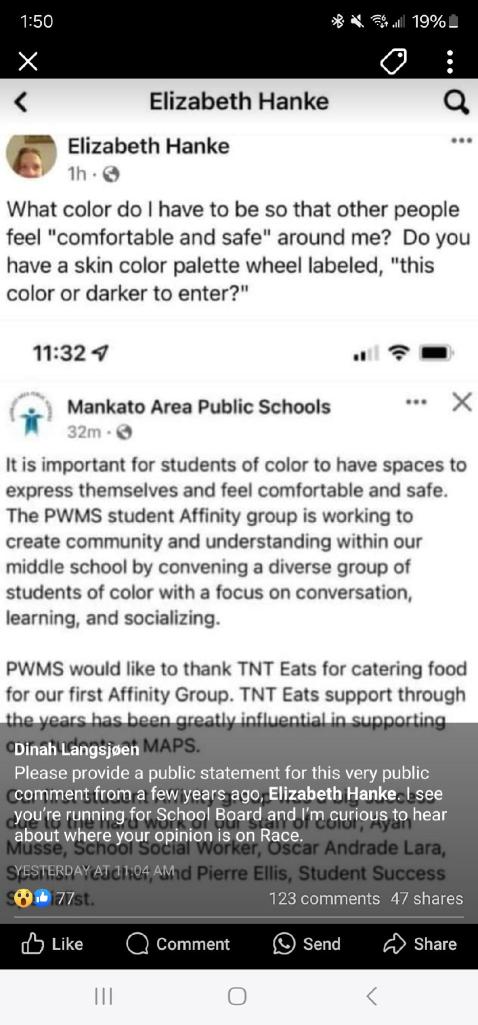
I also think it is important to take into consideration other events happening at the time. Our school was dividing student by race but they also just passed 122a.70.
In April 2022, I addressed what was said to me at a policy meeting. During the policy meeting I raised concerns regarding Minnesota State Statute 122A.70 (Mankato Area Public Schools Policy 466) and was told that I do not help the “right” type of people.
The statute and policy in question focus on providing financial support for professional learning community based on racial groups. I understand the district’s intent to address isolation and foster collegial support, but the assumption that grouping educators based solely on shared racial or ethnic identity will solve these issues is overly simplistic and reduces individuals to their race. Teachers should be valued for their character, not just their group identity. There is significant value in placing individuals with diverse perspectives and experiences into collaborative groups, which fosters richer learning environments. Moreover, policies like this could potentially violate Title VII, Title VI of the Civil Rights Act of 1964, and the Fourteenth Amendment, which prohibit discrimination based on race.


 Elizabeth Hanke for Mankato School Board
Leave a reply to Elizabeth Hanke Cancel reply