A Summary by Elizabeth Hanke: AJ Crabill’s Review of New Jersey Public School Strategic Plans
AJ Crabill’s review of 50 New Jersey public school district strategic plans asks a blunt question: are districts truly planning for better student achievement, especially in reading and math, or just planning on paper? New Jersey spends far more per student than most states, yet proficiency in literacy and math has slipped since 2019 and large achievement gaps remain.
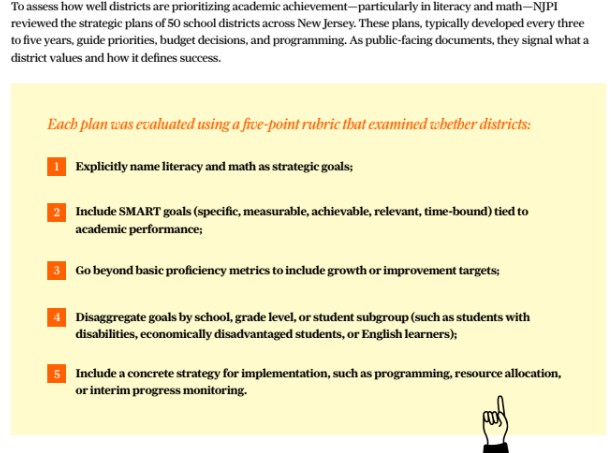
To see whether districts were using strategic plans as tools to change adult behavior and improve student outcomes, the New Jersey Policy Institute scored each plan on five things:
- Do they name literacy and math as explicit priorities?
- Do they set SMART academic goals (specific, measurable, time-bound)?
- Do they include growth or improvement targets, not just static measures?
- Do they disaggregate data by school or subgroup?
- Do they explain how progress will be implemented and monitored?
Most districts scored only 5–10 out of 20, showing weak focus on measurable academic outcomes and limited clarity about how plans will actually drive improvement. Some had no public plan at all. However, a few districts—like Ramsey, Brick Township, Camden, and Belvidere—stood out. They:
- Put student achievement at the top of the priority list,
- Set concrete, state-aligned proficiency targets,
- Built public dashboards or scorecards for transparency, and
- Linked goals to specific strategies and timelines.
Crabill’s conclusion: student outcomes don’t change until adult behaviors change, and adult behaviors don’t change at scale without focused, accountable strategic planning. Districts that adopt a small set of clear, public, SMART goals in literacy and math, monitor progress, and align resources accordingly are the ones most likely to move the needle for kids.
What a Real Strategic Plan Should Do
Crabill says a strong strategic plan is not a glossy brochure; it’s a tool for changing adult behavior in service of student outcomes. Done well, it answers three SMART, concrete questions:
- Student Outcomes (“Goals”)
- What are the big, 3–5 year SMART goals for what students will know or be able to do?
- Example: percent of students proficient in reading and math by a specific year.
- Student Outputs (“Interim Goals”)
- What ongoing, measurable indicators will leaders monitor to see if they’re on track?
- Think: quarterly benchmarks, on-track indicators, predictive data.
- Student & Adult Inputs (“Aligned Initiatives”)
- What specific strategies will staff and students implement day-to-day to hit those goals?
- For example: new curriculum, tutoring models, attendance interventions.
When these three pieces line up, a strategic plan becomes a public blueprint for improvement—a way to align time, talent, and money around student outcomes instead of scattered projects.
What the New Jersey Study Found
New Jersey spends more per student than almost any other state, yet too many students are still struggling with basic literacy and math. Proficiency rates are below pre-2019 levels, and large gaps persist by race and income.
To see whether districts were truly “planning for achievement,” NJPI reviewed 50 district strategic plans and rated them on whether they:
- Explicitly named literacy and math as core goals
- Used SMART academic goals (specific, measurable, time-bound)
- Included growth or improvement targets, not just status snapshots
- Disaggregated data by school, grade, or subgroup
- Described concrete plans for implementation and monitoring
Most districts scored between 5 and 10 out of 20—a clear sign that their plans talked about “academics” in general but rarely set sharp, measurable goals for reading and math. Some districts didn’t have a public plan at all.
Crabill’s verdict: this is a missed opportunity. With no clear goals and no monitoring system, it’s impossible to know whether adult behavior changes are helping or hurting students.
What “Good” Looks Like
The study also highlights districts that are using strategic plans well:
- Ramsey
- Names student achievement as the number-one priority.
- Sets explicit proficiency targets on the state test (NJSLA).
- Maintains a public dashboard families can easily understand.
- Uses real-time data and specific strategies (like numeracy screeners and revised unit assessments) to adjust instruction.
- Brick Township
- Sets a three-year goal to increase NJSLA proficiency by 5% across multiple grades.
- Aligns new curriculum work with those outcome targets.
- Organizes goals across student, teacher, and community dimensions, recognizing everyone’s role in academic progress.
- Camden
- Writes very precise SMART goals, including benchmarks for early literacy and math and targets for subgroups and chronic absenteeism.
- Belvidere
- Uses a public scorecard to show proficiency and subgroup performance in math and ELA.
- Breaks down which goals and strategies are on track, turning the plan into a real accountability tool.
- Cherry Hill
- Recently adopted a plan tying math and literacy goals to clear KPIs and action steps—another example of planning directly around student achievement.
These districts show that focus and transparency are possible even in the same policy and funding environment as everyone else.
The Big Takeaway for School Systems
Crabill’s message to boards and superintendents is both challenging and hopeful:
- If your strategic plan already has a small set of clear, public, SMART student outcome goals—keep going, keep learning, share what you’re doing.
- If it doesn’t, this is your nudge to refocus:
- Gather your community.
- Adopt a handful of SMART goals centered on student learning.
- Monitor progress relentlessly.
- Align resources with those goals.
- Report results back to the public in plain language.
When boards govern this way and superintendents lead this way, adult behavior changes, and student outcomes follow.
Full report here:
 Elizabeth Hanke for Mankato School Board
Leave a comment