Learning Loss
- Long-Run Effects of Disruptive Peers (Carrell, Hoekstra, & Kuka, 2016)
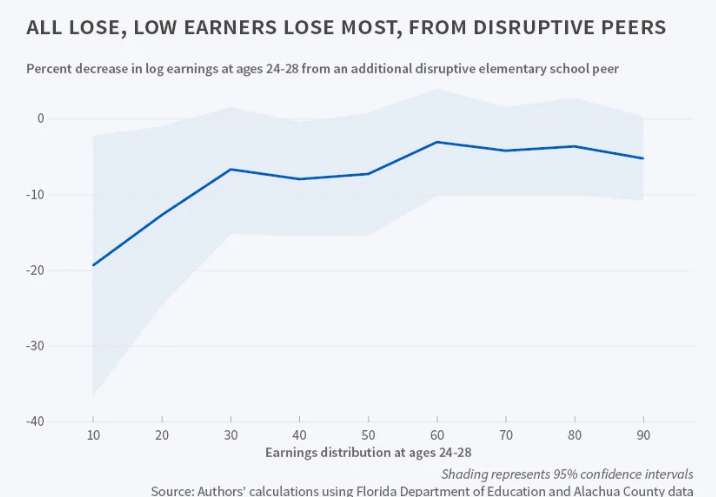
A study by the National Bureau of Economic Research (NBER) found that exposure to disruptive peers, such as those exhibiting aggressive or defiant behaviors, leads to significant long-term academic consequences. The research showed:- Students exposed to disruptive peers in elementary school had lower grades and test scores in the short term, which persisted into reduced college enrollment and lower earnings in adulthood.
- The effect was particularly pronounced for students from lower-income families, contributing to 5-6% of the “rich-poor earnings gap” in early adulthood.
- Disruptive behaviors, such as those linked to domestic violence or other household dysfunctions, were shown to reduce instructional time and create an environment less conducive to learning.
(NBER)
- Classroom Disciplinary Climate and Achievement (ResearchGate, 2025)
A study examining student reports of disruptive behaviors found that a disruptive classroom climate negatively correlates with academic achievement:- Disruptions, including physical acts like throwing objects, were associated with lower test scores across the class, regardless of individual student behavior.
- The study highlighted that time spent managing disruptions reduces instructional time, hindering the learning process for all students.
- Socioeconomic factors amplified the impact, with students from disadvantaged backgrounds showing greater academic declines in disruptive settings.
(Research Gate and Carmel Black)
- Transactional Relationships Between Behavior and Academic Performance (PMC, 2022)
A longitudinal study using data from the Early Childhood Longitudinal Study (2011) investigated how externalizing behaviors (e.g., fighting, impulsivity, or disruptive acts) affect academic performance from kindergarten to third grade:- Externalizing behaviors, such as aggressive or disruptive actions, predicted poorer reading and math performance over time.
- The study noted a bidirectional relationship, where poor academic performance also exacerbated behavioral issues, creating a cycle of learning loss and disruption.
- Early interventions targeting both behavior and academics were suggested to mitigate long-term academic deficits.
(NIH)
Mental Health Impacts
- Disruptive Peers and Mental Well-Being (ScienceDirect, 2021)
A study exploring the spillover effects of disruptive students (e.g., those from troubled families or with behavioral issues) found:- Classmates exposed to disruptive peers, such as those engaging in harmful behaviors, experienced worse social-emotional outcomes, including increased emotional distress, reduced school engagement, and poorer social relationships.
- The effects were stronger with prolonged exposure and among students from lower socioeconomic backgrounds.
- The study emphasized that disruptions damage inter-student relationships, contributing to a less supportive classroom environment.
(ScienceDirect)
- Trauma and Classroom Behavior (PMC, 2023)
Research on trauma-informed education highlighted how traumatic experiences, which may manifest as disruptive behaviors like throwing chairs, impact mental health:- Traumatized students often exhibit fight-or-flight responses (e.g., aggression or defiance), which disrupt classroom dynamics and increase stress for peers and teachers.
- These behaviors can lead to a classroom environment perceived as unsafe, contributing to anxiety, depression, and reduced trust in authority figures among other students.
- The study advocates for trauma-informed practices to reduce the mental health toll on both disruptive students and their peers.
(NIH, ScienceDirect)
- Teacher Stress and Mental Health (PMC, 2017)
Disruptive classroom behaviors also affect teachers’ mental health, which can indirectly influence students:- Over 40% of teachers report high levels of work stress due to managing disruptive behaviors, which can impair teaching quality and exacerbate student mental health issues.
- Stress from disruptions may lead to less flexible teaching practices, further hindering student engagement and contributing to a negative classroom climate.
(NIH)
- Mental Health Issues in Schools (NAMI, 2023)
The National Alliance on Mental Illness notes that disruptive behaviors are often linked to underlying mental health conditions:- One in six U.S. youth experience a mental health disorder annually, with half of conditions beginning by age 14. Disruptive behaviors can be a manifestation of untreated issues like ADHD, anxiety, or depression.
- Schools with frequent disruptions see higher rates of student anxiety and lower satisfaction with the learning environment, impacting long-term mental health outcomes.
(NAMI)

Long-Term Ramifications
- Academic Trajectories: Studies consistently show that early disruptions contribute to persistent academic underachievement, lower high school graduation rates, and reduced college enrollment. For example, the NBER study found that exposure to disruptive peers in elementary school reduced adult earnings, particularly for lower-income students.
(NBER)
- Mental Health Outcomes: Prolonged exposure to disruptive environments is linked to increased risks of anxiety, depression, and social isolation in adolescence and adulthood. The stress of an unsafe or chaotic classroom can exacerbate existing mental health issues and create new ones.
(ScienceDirect)
- Socioeconomic Disparities: Students from disadvantaged backgrounds are more vulnerable to the effects of disruptive classrooms, perpetuating cycles of inequality through reduced academic and career opportunities.
(ResearchGate and Carmel Blank)

Gaps and Considerations
- Many studies focus on short-term academic impacts, with less data on lifelong mental health outcomes. Longitudinal research tracking students into adulthood is limited.
- The role of specific disruptive behaviors (e.g., throwing chairs vs. verbal outbursts) is often not disaggregated, making it harder to pinpoint the impact of extreme actions.
- Cultural and contextual factors, such as school resources or community support, can moderate outcomes but are underexplored.
Recommendations from Research
- Early Interventions: Programs like Second Step and First Step, which teach social-emotional skills, have been shown to reduce disruptive behaviors and improve academic engagement.
(AFT)
- Trauma-Informed Practices: Training educators to recognize and address trauma can mitigate disruptive behaviors and their mental health impacts.
(ScienceDirect)
- Positive Behavioral Supports: Positive Behavioral Interventions and Supports (PBIS) emphasize proactive strategies to create a supportive classroom environment, reducing the incidence of harmful behaviors. (Effective School Solutions)
- Mental Health Resources: Schools should integrate mental health services to address underlying issues driving disruptive behaviors, benefiting both the disruptors and their peers.
(NAMI)
NAMI-
https://www.nami.org/advocacy/policy-priorities/improving-health/mental-health-in-schools/

https://effectiveschoolsolutions.com/8-strategies-to-manage-challenging-classroom-behaviors/
ScienceDirect – https://www.sciencedirect.com/science/article/pii/S2773233923000049
AFT-
https://www.aft.org/ae/winter2003-2004/walker_ramsey_gresham
ResearchGate and Carmel -Blankhttps://www.researchgate.net/publication/304575369_The_Association_Between_Student_Reports_of_Classmates_Disruptive_Behavior_and_Student_Achievement
Science Direct – ://www.sciencedirect.com/science/article/abs/pii/S0927537120301585
NBER –
https://www.nber.org/digest/may16/disruptive-students-affect-long-term-prospects-their-classmates
NIH –
https://pmc.ncbi.nlm.nih.gov/articles/PMC6380371/
Related Blogs:
 Elizabeth Hanke for Mankato School Board
Leave a comment