
As a school board member, I’ve heard from constituents seeking clarity on whether school staff can diagnose students with mental health conditions or address disruptive behaviors potentially linked to special education services.
To better understand these issues, I attended a leadership training on April 3, 2025, focused on special education and classroom safety, led by Alyssa Wright and Erica Ramsey. This training was for School Board Members across the nation.
My 4 key takeaway:
- Role of School Staff
School staff, including counselors and nurses, do not diagnose or treat medical conditions. Instead, they provide educational supports to ensure students with disabilities can access their education, such as helping a student with anxiety reintegrate into classrooms. This aligns with the Individuals with Disabilities Education Act (IDEA), which focuses on educational services, not medical treatment. (Minnesota Department of Education – Special Education).
Policy Alignment
- Minnesota Statutes Chapter 125A defines the scope of special education, focusing on instructional and related services, reinforcing that medical diagnosis is outside school staff’s role.
2. Importance of Involving Parents in Decision Making
A cornerstone of effective special education is the meaningful involvement of parents and guardians in decision-making processes. The Individuals with Disabilities Education Act (IDEA) mandates parental participation in the development of Individualized Education Programs (IEPs), recognizing that families offer critical insights into a child’s needs, strengths, and history. Active collaboration ensures that educational strategies are tailored and practical, fostering stronger outcomes for students.
Minnesota’s special education framework reinforces this by emphasizing family engagement as a pillar of inclusive practice. When schools listen to and involve parents, trust is built, concerns are addressed early, and more comprehensive, student-centered plans can be developed. This partnership not only supports the academic and emotional success of the child but also aligns with the broader goals of preparing students for reintegration into general education and community life.
3. Goal and Inclusive Practices
The ultimate goal appears to be helping students exit special education by preparing them for general education through inclusive practices, ensuring they participate in everyday school activities. This supports their reintegration into society, as emphasized in Minnesota’s special education framework. This goal is supported by the Least Restrictive Environment (LRE) principle, aiming for integration into general education, as outlined in Minnesota House Research – Special Education Terms.
Implementation
- The training highlighted the need to assess exit success, aligning with Minnesota’s emphasis on inclusive education to prepare students for societal reintegration.
4. Due Process and Data Systems
Due process is crucial for resolving disputes, with IEPs needing to be data-driven and focused on necessary educational supports. Discipline and identification data must be tracked to ensure equity, preventing over- or under-identification of specific student subgroups. This is a core component of Minnesota’s special education framework, ensuring participation in school life to foster independence.
Policy Support:
- Minnesota’s Olmstead Plan, part of special education administration, aims for the most integrated settings, supporting inclusive practices (Minnesota Department of Education – Special Education).
MY NOTES:
Any (*) is my additional research beyond the training session.
Goal: Exiting from Special Education
- The ultimate goal should be to help students exit special education services.
- Are we successfully exiting students?
Inclusive Practices
- Students need to be included in everyday activities.
- Purpose: To help them reintegrate into general society effectively.
Due Process and IEP Implementation
- There’s no reason to fear due process if we’re doing our jobs correctly.
- Not everything belongs in an IEP—focus should be on what’s necessary.
- Supports and services must be data-driven.
Staff Support and Training
- Is there job-embedded support for staff?
- Are principals being trained alongside their teams?
Data and Reporting Systems
- Discipline data: Are we tracking it effectively?
- Are we over or under-identifying students from specific subgroups?
- Transition services: Are they connected to adult services for a smooth handoff?

Therapy in Schools
*Ensure students have skills to utilize school services effectively, as outlined in Minnesota’s special education guidelines (Minnesota Department of Education – Special Education).
- Schools do not provide therapy.
- Counselors, social workers, and behavioral analysts are not therapists.
- We need job descriptions tailored to school settings, not therapeutic roles.
- These professionals can address specific issues like school phobia to help students access the school environment.
- Obligation: Ensure students have the skills to utilize school services effectively.
Funding Allocation
- Money should be reallocated to enhance support services.
Early Intervention Transition
- What are the profiles or needs of students transitioning from early intervention programs?
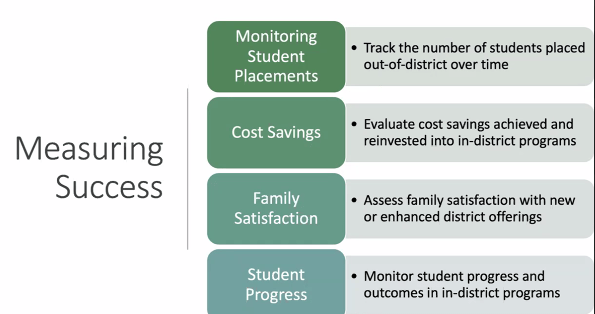
Understanding behavior and teach behavior properly. More professional development.
Wright path.
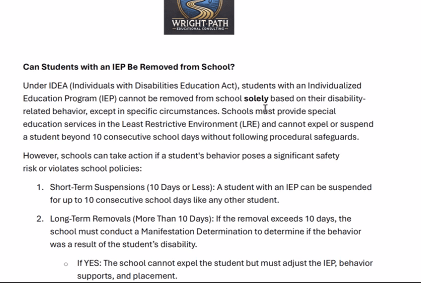
Drugs, weapons and bodily harm, is a carve out for 45 days of suspensions. Fear of litigation? A lot of that happens if our documents are not up to standards.
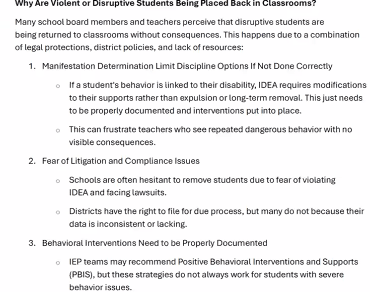
*This aligns with discipline policies in Minnesota House Research – Special Education Terms.
F>A>P>E waiver.
*A Free Appropriate Public Education (FAPE) waiver, where parents may sign away FAPE rights, often in settlement agreements. This is not specific to Minnesota but aligns with general special education law, as seen in discussions on waiving FAPE (FAPE Waiver: When Should a Parent Sign Away FAPE for their Child?).
Replacement Behaviors and Resource Use
- Focus on teaching appropriate replacement behaviors.
- We may need to acknowledge when we’ve exhausted all available resources and consider moving students to a more suitable placement.
*Tables for Clarity
Below is a table summarizing key roles and policies related to diagnosing and managing behaviors:
| Area | School Staff Role | Policy Reference |
|---|---|---|
| Diagnosing Mental Health | Do not diagnose; refer to licensed professionals. | IDEA, Minnesota Statutes Chapter 125A |
| Managing Disruptive Behaviors | Provide supports via IEPs, BIPs, and PBSPs. | Minnesota Statutes Section 125A.094, Minnesota House Research – Special Education Terms |
| Training and Support | Focus on job-embedded training, data-driven practices. | MDE Guidance on Professional Development |
Communication Challenges
*This is crucial for maintaining support, aligning with Minnesota’s emphasis on person-centered practices in special education (Minnesota Department of Education – Special Education).
- We’re doing great initially, but then we “pull the rug out” by disrupting progress.
- Solution: Improve communication to maintain consistency and support.
IEP Purpose and Litigation
*Due process is an opportunity to refine practices, aligning with Section 125A.091 of Minnesota Statutes, ensuring thorough documentation.
- An IEP is not about achievement—it’s a goal for where the child should be by the end of the year.
- We’re not litigation-averse; if documentation is thorough, we’ll be fine.
- Due process is an opportunity to refine our practices.
Discipline Policies and Reporting
*This ensures students receive needed services, aligning with Minnesota’s discipline procedures in Minnesota House Research – Special Education Terms.
- Are discipline policies clear, and is reporting consistent?
- If teachers fear asking for help, situations can spiral out of control.
- What can we do to ensure students receive the services they need?
Serious Bodily Injury
- Proving serious bodily injury is difficult.
- Legal counsel defines it as intent to permanently maim an individual.
- Repeated skin-breaking incidents: Hearing officers typically side with staff.
School Safety Plans and Restraints
*Expectations for restraint align with Section 125A.094 of Minnesota Statutes.
- School plans need a clear chain of command.
- Restraints are allowed—what’s the plan?
- Must be outlined in the Positive Behavior Support Plan (PBSP) and IEP.
- Arm and leg guards can be purchased for staff protection.
- Expectations for restraint use must be explicitly outlined.
Support Staff
- Ensure appropriate support staff, including behavioral analysts, are in place.
No one should go to work with the fear of getting injured.
Comp ed fund, through a settlement agreement.
Director of pupil services.
Appropriate training for IEP’s
Ton of money in settlements
How many kids out of the districts
Pupil services. Settlement agreements and why? A week before the school board meeting she would send an email to superintendent.
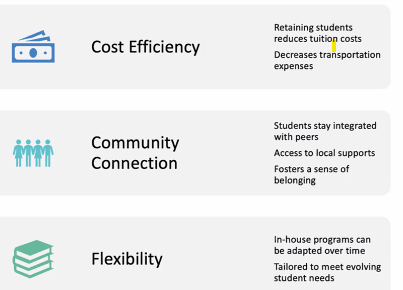
*Tuition rates and IEP charge-backs are calculations ensuring districts break even, as seen in funding discussions in Sections 125A.74 to 125A.81.
Expediated due process hearing. Substantially likely to create harm to student, or staff.
Tables for Clarity
Below is a table summarizing key Minnesota special education policies relevant to the takeaways:
| Policy Area | Details |
|---|---|
| FAPE (Free Appropriate Public Education) | Must provide disabled students a free appropriate K-12 education through age 22, per IDEA and state law. Minnesota Department of Education guidance. |
| IEP Requirements | Describes current performance, goals, services, and evaluation, developed with parents. |
| LRE (Least Restrictive Environment) | Educate in the least restrictive setting, maximizing integration with non-disabled peers. |
| Due Process | Includes alternative dispute resolution and hearings, ensuring parental rights (Section 125A.091). |
| Restrictive Procedures | Governed by Section 125A.094, must be outlined in PBSP and IEP, with safety measures. |
| Funding | Covers medical assistance, special education aid, and excess cost aid (Sections 125A.74 to 125A.81). |
This table encapsulates key policy areas, ensuring alignment with training insights.
Key Citations
 Elizabeth Hanke for Mankato School Board
Leave a comment