
In early November 2022, I received a text message inquiring about my knowledge of the Coffee and Conversations meeting, which I often attend but was canceled in 2022. During this session, a cohort of teachers expressed their belief in placing students in classes according to their abilities. They found it disheartening to have students unable to read put in regular classes, advocating instead for remedial services. They cited that nearly 20% of 9th-grade students (at the time) were reading below a 3rd-grade level.
During the discussion, a school board member challenged the teachers, questioning how they could determine so many students’ reading abilities. In response, the teachers pointed to Lexile test scores and their professional experience, asserting that they interact with these students daily and can gauge their reading capabilities firsthand.
Later, at a school board meeting(minute 3:32), Kari Pratt spoke passionately about these teachers’ concerns, emphasizing that many do not feel safe. It’s a powerful speech, and I highly recommend watching it.
The Director of Administrative Services at Mankato Area Public Schools said, “Staff would like us to ask how they are doing. We often check in on them about how school is going … but not how they are doing as individuals. How are their peers doing? Staff wants the opportunity to share feedback and give input, but they want it conducted in a safe and productive manner without the fear of retaliation.”
Moving froward 2022 to 2024
In April 2024, a teacher from that original meeting spoke to our school board to address ongoing concerns about remedial services in our schools. What our teacher said:
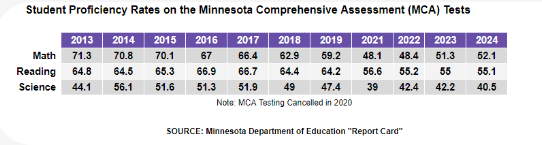
One of our core values as a district is “accountability for results.” To uphold this, we must address the concerning reality of our district’s poor financial management and its impact on students’ education, especially regarding graduating students who are functionally literate. According to the Minnesota Report Card, the percentage of District 77 students meeting reading standards has dropped nearly 10 points over the past five years. While the pandemic years brought challenges, we cannot continue to blame COVID for all of our setbacks. As our core values state, we need to be accountable for results.
Let’s examine that accountability: just a year ago, the district made the decision to eliminate all media specialist positions in our middle and high schools, leaving us with just one library media specialist covering four schools. Our once-bustling libraries are now mere shells of their former selves. Occasionally, someone is available at the desk to check out books, but the clear message sent to students is that reading is not a priority. Beginning in September 2024, there will be no reading intervention programs beyond fifth grade, meaning that students who still struggle with reading in sixth grade and beyond are simply left behind.
Students who are far below grade level might receive additional support from English teachers, but even this is nearly impossible with the large class sizes resulting from budget cuts. At East, the System 44/Read 180 intervention program is being eliminated. This research-based, data-driven, nationally recognized program—taught by a specially trained teacher—has helped our lowest-performing students rise out of functional illiteracy, including some who, even in ninth grade, struggle with sentences as simple as “Pat sat on a log.” Next year, students reading at that level will be expected to jump from these books to grade-level textbooks in subjects like social studies and science, all without the needed support. They’ll be in crowded English classes, without the focused attention they need, setting them up for failure and potentially pushing them into night school. Here, they’ll face grade-level online curricula, which may drive them to either attempt to “chatGPT” their way through it or, more likely, give up altogether. Imagine the frustration of being placed in that situation!
This frustration spills into every area of school life, compounded by students’ lack of emotional support, safety, and sense of belonging. Each day, our teachers pull together, showing up with determination and giving their best, even as class sizes grow and teaching positions dwindle. As one teacher put it, “At some point, we’re no longer going to be able to cobble together a seven-course meal out of ground horse meat and government cheese. The district can rally funds for pools, athletic fields, and new meeting room furniture, but when it comes to full-time teaching personnel working directly with students, we’re suddenly ‘still recovering from a budget deficit.’ Our core values include accountability for results, and right now, we’re holding you accountable. What’s happening in District 77 is nothing short of educational malpractice, and as part of this district, we’re made complicit.”
My Statement Thoughts
It would be difficult to ask the community for more funding, especially after recent tax increases for the building bond and with so many residents facing inflation pressures. We should explore ways to reduce administrative costs and minimize unproductive meetings to refocus on classroom services.
What are your thoughts?
Thanks,
ElizaBeth Hanke
Related Video’s :
Revealing the Truth Behind Mankato MCA Test Scores
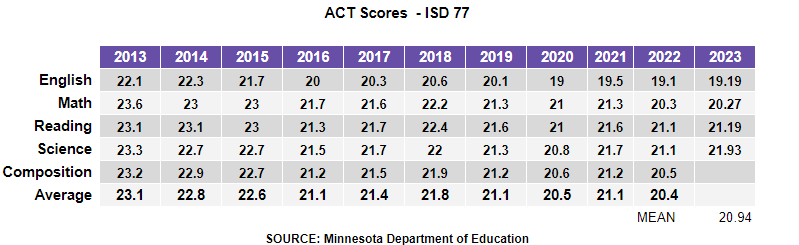
ACT Test scores MN Report Card

 Elizabeth Hanke for Mankato School Board
Leave a comment